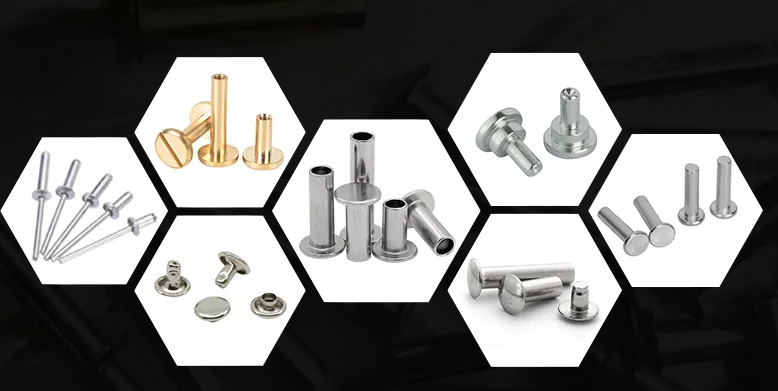
In the intricate world of precision mechanical assemblies, standard fasteners often fail to meet the dual requirements of secure clamping and dynamic movement. When an assembly dictates that a component must pivot, rotate, or maintain a strict axial clearance, the shoulder rivet (or shoulder pin) becomes an irreplaceable engineering solution.
Unlike generic solid or blind rivets designed for static clamping, shoulder rivets are highly specialized components. They integrate the functions of a fastener, an axle, and a precision spacer into a single piece of hardware.
This guide explores the mechanical principles, metallurgical requirements, and design tolerances necessary for specifying custom shoulder rivets in high-performance industrial applications.
1. The Anatomy and Core Functions of a Shoulder Rivet
The defining characteristic of a shoulder rivet is its stepped shank, which divides the fastener into three distinct functional zones: the Head, the Shoulder (the precision bearing surface), and the Tenon (the tail that gets upset/clinched).
This unique geometry allows the shoulder rivet to perform three critical mechanical functions simultaneously:
- Precise Spacing (Standoffs): The shoulder acts as an unyielding spacer. When the tenon is clinched against the mating material, the shoulder bottoms out, guaranteeing an exact, non-compressible distance between two parallel components (e.g., separating stacked PCBs).
- Frictionless Pivoting: By designing the mating hole with a slight clearance fit (e.g., an H7/g6 tolerance fit), the shoulder acts as a smooth axle. This allows linkages, levers, or hinges to rotate freely without axial slop.
- Positive Locating (Alignment): In automated fixtures, the precisely machined shoulder acts as a dowel pin, aligning multiple plates with micron-level accuracy before the joint is permanently secured.
2. Engineering Tolerances: The Manufacturing Reality
The true value of a shoulder rivet lies in its dimensional accuracy. A generic rivet may have a shank tolerance of ±0.1mm. In contrast, a precision shoulder rivet requires strict micro-tolerances to function correctly.
Controlling Radial Play
If a shoulder rivet is used as a pivot point in a multi-bar linkage (such as an automotive wiper mechanism or an aerospace flap actuator), any discrepancy between the shoulder diameter and the bore creates “radial play.” This microscopic slop multiplies across the length of the linkage, causing severe vibration and rapid wear. Custom shoulder rivets are often CNC secondary-machined to hold diameter tolerances as tight as ±0.015mm to eliminate this issue.
Managing Axial Clearance
The length of the shoulder dictates the axial clearance of the rotating part. If the shoulder is too short, the clinching process will clamp the rotating arm tight, seizing the mechanism. If it is too long, the arm will rattle. Premium OEM manufacturers utilize advanced cold-heading machinery to ensure strict consistency in shoulder length across production batches.
3. Metallurgy and Surface Engineering for Extreme Environments
Selecting the right base material and coating is critical for preventing premature fatigue or galvanic corrosion in the field.
| Material / Coating | Key Characteristics | Ideal Industrial Applications |
| 316L / 304 Stainless Steel | High tensile strength, superior pitting resistance in chloride environments, naturally passivated. | Medical surgical instruments, marine hardware, food processing equipment. |
| High-Carbon & Alloy Steel (e.g., 4140) | Exceptional shear strength. Often heat-treated (quenched and tempered) for high-load applications. | Automotive door hinges, heavy machinery linkages, industrial automation. |
| Titanium Alloys (Ti-6Al-4V) | Unmatched strength-to-weight ratio, complete biocompatibility, non-magnetic. | Aerospace flap pivots, MRI machine components, orthopedic implants. |
| Brass & Copper Alloys | Excellent electrical/thermal conductivity, anti-sparking, natural lubricity for pivots. | Electronics, server chassis standoffs, explosive environment equipment. |
| Electroless Nickel Plating | Provides a uniform, hard, and highly lubricious surface over steel, eliminating galling in pivot applications. | High-cycle robotic joints, precise sliding mechanisms. |
4. The Clinching Process: Avoiding Installation Failures
A precision shoulder rivet is only as good as its installation. The method used to upset the tenon (tail) must be carefully controlled to avoid distorting the critical shoulder dimension.
- Impact Riveting: While fast, using a standard pneumatic hammer can shock the fastener, potentially swelling the shoulder and seizing the pivot joint.
- Orbital / Radial Riveting: This is the gold standard for precision shoulder rivets. A peen tool spins and applies gradual, radial pressure to the tenon. This flows the metal smoothly without applying excessive downward force, ensuring the shoulder remains perfectly intact and the rotating component remains free.
- Localized Annealing: For extremely hard alloy rivets, manufacturers like RivetJL can selectively anneal only the tenon. This leaves the shoulder hardened for maximum wear resistance while making the tail ductile enough to roll cleanly without cracking.
5. Partnering with RivetJL for Custom Fastening Solutions
Standard catalog fasteners simply cannot meet the diverse geometric constraints and tolerance requirements of modern precision engineering.
At RivetJL (Jiliang Fastener Manufacturing), we bridge the gap between mass production and bespoke engineering. We specialize in the custom manufacturing of high-precision shoulder rivets tailored to your exact CAD blueprints.
Our OEM capabilities include:
- Advanced Cold Heading & CNC Machining: Capable of producing complex shoulder geometries with micron-level concentricity and surface finish.
- 100% Optical Sorting: Automated laser and camera inspection systems guarantee 0 PPM dimensional defects in your supply chain.
- Comprehensive Quality Documentation: Full PPAP Level 3 documentation, material certifications, and salt-spray testing reports available for rigorous automotive and aerospace compliance.
Do not let an off-the-shelf fastener compromise your precision assembly. Contact the engineering team at RivetJL today to discuss your project requirements, request a custom prototype, and secure the ultimate fastening solution for your supply chain.