Fasteners are the unsung heroes of countless products, holding everything from aircraft to furniture together. But when it comes to ensuring optimal structural integrity, not all rivets are created equal. You’ve got your workhorse male-female rivets and your versatile blind rivets, and knowing when to pick which one can make or break your project. It’s not just about “a rivet will do”; it’s about precision engineering and smart choices.
Male-female rivets are ideal for applications requiring high shear and tensile strength, a clean two-sided finish, and where both sides of the joint are accessible for installation, offering superior structural integrity through a solid, interlocking connection. Conversely, blind rivets are indispensable when access is limited to only one side of the joint, providing a quick, efficient, and reliable fastening solution, though generally with lower ultimate strength compared to properly installed male-female rivets, making their selection dependent on accessibility, load requirements, and aesthetic needs.
This article will break down the key differences, helping you decide whether male-female rivets or blind rivets are the champions for your specific structural needs. Let’s dive in!
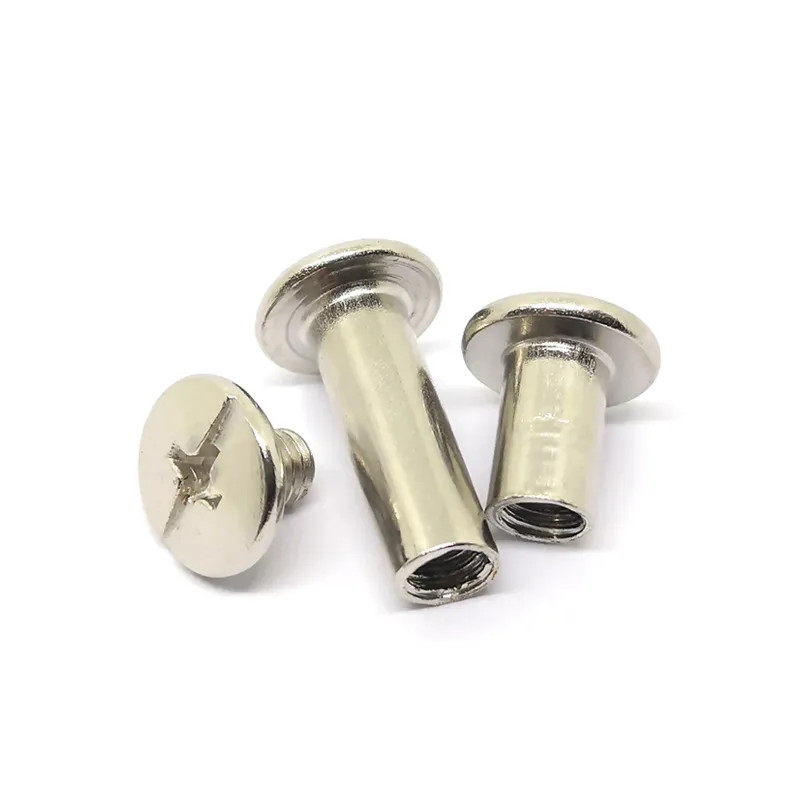
Table of Contents
- Understanding Male-Female Rivets: Strengths and Applications
- Understanding Blind Rivets: Strengths and Applications
- Key Differences: Installation, Strength, and Accessibility
- Choosing the Right Rivet for Optimal Structural Integrity
- Common Misconceptions and Best Practices
1. Understanding Male-Female Rivets: Strengths and Applications
Male-female rivets, also known as Chicago screws, sex bolts, or binding posts, are a two-piece fastener system that creates a strong, aesthetically pleasing joint when both sides of the material are accessible.
Male-female rivets offer superior structural integrity due to their solid, interlocking design, providing excellent shear and tensile strength, making them ideal for applications where high load-bearing capacity and a clean, finished appearance on both sides are critical. They are best used when both sides of the joint are accessible for installation, commonly found in leather goods, architectural panels, and heavy-duty assemblies requiring robust, often decorative, and sometimes reusable fastening.
1.1 Design and Installation Mechanics
A two-part system for a solid hold.
- Design: A male-female rivet consists of two separate components: a male screw (or post) with an external thread or a smooth barrel, and a female barrel (or nut) with an internal thread or a hollow barrel that the male part inserts into. The male part is typically driven into the female part, creating a secure, interlocking connection.
- Installation: Installation requires access to both sides of the material. The male part is inserted from one side, the female part from the other, and then they are joined, often by screwing or pressing them together.
- Example 1: Heavy-Duty Leather Belts. For a thick leather belt, male-female rivets are often used. The male post goes through one side, the female barrel through the other, and they screw together, creating a very strong, visually appealing, and often reusable joint that can withstand significant tension and bending without failure.
- Example 2: Architectural Panels. In modern architecture, decorative panels might be joined using male-female rivets. The ability to have a finished head on both sides, combined with high strength, makes them suitable for visible structural elements where aesthetics are important.
- Analysis: The theoretical basis is the creation of a solid, continuous load path through the joined materials, offering high resistance to both shear (forces parallel to the joint) and tensile (pull-apart) forces. The practical impact is a highly robust and durable joint.
This table highlights the characteristics of male-female rivets.
| Characteristic | Description | Impact on Structural Integrity |
| Two-Piece Design | Male post and female barrel | Creates a solid, interlocking connection |
| Installation | Requires access to both sides of the joint | Allows for precise alignment and strong clinch |
| Strength | High shear and tensile strength | Excellent for load-bearing applications |
| Aesthetics | Finished head on both sides, often decorative | Clean, professional appearance, can be a design feature |
| Reusability | Often designed to be unscrewed and reused | Facilitates maintenance, disassembly, and reassembly |
| Material Thickness | Excellent for varying and thicker material stacks | Accommodates a wide range of grip lengths |
1.2 Optimal Applications for Male-Female Rivets
Where strength and appearance matter.
- High-Load Assemblies: Any application where the joint will experience significant shear or tensile forces, and where a solid, non-deforming connection is paramount.
- Visible Fasteners: When the fastener will be seen from both sides and needs to contribute to the product’s aesthetic.
- Thick or Multi-Layer Materials: Their design allows for precise grip length adjustment, making them ideal for joining varying thicknesses of materials like leather, fabric, or stacked panels.
- Example 1: Custom Bookbinding. For high-quality, durable bookbinding, male-female rivets provide a strong, elegant spine connection that can withstand repeated opening and closing, unlike adhesives or staples that might fail over time.
- Example 2: Automotive Interior Trim (Specific). In certain high-end automotive interiors, where trim pieces need to be securely fastened and potentially removed for maintenance, male-female rivets offer a robust, reusable solution with a premium finish.
- Analysis: The practical impact is that male-female rivets are chosen when the application demands a combination of high structural integrity, aesthetic appeal, and sometimes the ability to be disassembled and reassembled without damaging the joint.
2. Understanding Blind Rivets: Strengths and Applications
Blind rivets, also known as pop rivets, are single-piece fasteners designed for situations where access is limited to only one side of the material being joined.
Blind rivets are invaluable for achieving optimal structural integrity in applications where only one side of the joint is accessible for installation, offering a quick, efficient, and reliable fastening solution. While generally providing lower ultimate strength than solid male-female rivets, their ability to create a secure joint from a single side makes them indispensable in aerospace, automotive, and construction for enclosed structures, tubing, or panels where back-side access is impossible or impractical.
2.1 Design and Installation Mechanics
The one-sided wonder.
- Design: A blind rivet consists of a rivet body (often tubular) and a mandrel (a pin-like component) that runs through the center of the body. The head of the mandrel is at the tail end of the rivet body.
- Installation: A specialized rivet gun (manual or pneumatic) is used. The rivet is inserted into a pre-drilled hole. The gun pulls the mandrel, which deforms the tail end of the rivet body, creating a “blind” head on the inaccessible side. Once the joint is formed, the mandrel snaps off, leaving a securely fastened joint.
- Example 1: Aircraft Assembly. In aircraft manufacturing, many internal structures and panels are riveted using blind rivets because access to the inside of the fuselage or wing is impossible once certain sections are closed. The blind rivet allows for a strong, lightweight joint from the exterior.
- Example 2: HVAC Ductwork. For joining sections of HVAC ductwork, blind rivets are ideal. They allow technicians to quickly and securely fasten sheet metal from the exterior of the duct, even when the interior is inaccessible.
- Analysis: The theoretical basis is controlled deformation to create a secure mechanical interlock. The practical impact is the ability to create strong joints in situations where traditional two-sided fastening methods are impossible, significantly expanding design possibilities.
This table highlights the characteristics of blind rivets.
| Characteristic | Description | Impact on Structural Integrity |
| Single-Piece Design | Rivet body with a mandrel | Simplifies installation, no loose parts |
| Installation | Requires access to only one side of the joint | Essential for enclosed structures, tubing |
| Strength | Good shear strength, moderate tensile strength | Reliable for many applications, but generally lower than solid rivets |
| Aesthetics | Only one finished head visible | Functional appearance, less decorative |
| Speed | Fast and efficient installation | Ideal for high-volume production |
| Material Thickness | Specific grip ranges, less forgiving than male-female | Requires careful selection for material thickness |
2.2 Optimal Applications for Blind Rivets
Where accessibility is the challenge.
- Enclosed Structures: Any assembly where the back side of the joint is inaccessible, such as tubing, boxes, or internal panels.
- High-Volume Production: The speed and simplicity of installation make them excellent for automated or semi-automated assembly lines.
- Thin Sheet Metal: Often used for joining thin gauge metals where welding might cause distortion or be impractical.
- Example 1: Automotive Body Panels (Non-Structural). For attaching non-structural trim or brackets to automotive body panels, blind rivets offer a fast and effective solution, especially when working in tight spaces.
- Example 2: Electronics Chassis. In the assembly of computer cases or other electronic chassis, blind rivets can quickly secure internal components or panels where reaching the back side with a tool is impossible.
- Analysis: The practical impact is that blind rivets enable efficient and reliable assembly in challenging environments, making them indispensable for a wide range of industries.
3. Key Differences: Installation, Strength, and Accessibility
While both are rivets, their fundamental differences in design and installation lead to distinct performance characteristics.
The key differences between male-female rivets and blind rivets lie in their installation, strength, and accessibility requirements. Male-female rivets require two-sided access, offer superior shear and tensile strength due to their solid, interlocking connection, and provide a clean finish on both sides. Blind rivets, conversely, are installed from one side, offer good but generally lower ultimate strength, and are indispensable for inaccessible joints, making the choice dependent on specific structural demands, assembly constraints, and aesthetic priorities.
3.1 Installation Method and Accessibility
The most obvious distinction.
- Male-Female Rivets:
- Installation: Requires access to both sides of the material. One part is inserted from one side, the other from the opposite side, and then joined.
- Accessibility Impact: Limits their use to open assemblies or where components can be temporarily moved to allow two-sided access.
- Blind Rivets:
- Installation: Requires access to only one side of the material. A rivet gun pulls a mandrel, forming a blind head on the inaccessible side.
- Accessibility Impact: Makes them ideal for enclosed structures, tubing, or any situation where the back side of the joint cannot be reached.
- Example: Imagine fastening a bracket inside a sealed metal box. A male-female rivet would be impossible to install. A blind rivet is the only practical solution, installed from the outside.
- Analysis: The practical impact is that accessibility dictates the initial feasibility of using either rivet type. If you can’t reach both sides, blind rivets are your go-to.
This table directly compares male-female and blind rivets.
| Feature | Male-Female Rivets | Blind Rivets |
| Installation Access | Requires two-sided access | Requires one-sided access (blind side) |
| Structural Strength | Higher shear and tensile strength (solid connection) | Good, but generally lower ultimate strength |
| Aesthetics | Finished head on both sides, often decorative | Finished head on one side only, functional |
| Reusability | Often reusable (e.g., screw-type) | Permanent (non-reusable) |
| Installation Speed | Generally slower, more manual | Generally faster, especially with power tools |
| Material Thickness | Accommodates wider range of grip lengths | Specific grip ranges, less forgiving |
| Vibration Resistance | Excellent, especially when properly torqued | Good, but can loosen over time if not properly selected |
3.2 Strength and Load-Bearing Capacity
How much can they really hold?
- Male-Female Rivets:
- Strength: Generally offer superior shear and tensile strength. Because they create a solid, interlocking connection, the load is distributed more effectively across the entire cross-section of the rivet and the joined materials.
- Load-Bearing Impact: Ideal for critical structural joints that experience high static or dynamic loads.
- Blind Rivets:
- Strength: Provide good shear strength, but their tensile (pull-out) strength can be more variable, depending on the rivet type (e.g., standard vs. structural blind rivets) and the quality of the blind-side formation. The hollow nature and the way the blind head forms can sometimes create stress concentrations.
- Load-Bearing Impact: Suitable for many applications, but for extremely high-load or fatigue-prone joints, male-female or other solid fasteners might be preferred.
- Example: For a critical structural beam in a building, a male-female rivet (or a similar solid fastener) would be chosen over a blind rivet due to its inherently higher and more predictable load-bearing capacity.
- Analysis: The theoretical basis is material mechanics and joint design. A solid, well-formed joint (like a male-female rivet) typically offers better stress distribution and higher ultimate strength. The practical impact is that understanding these strength differences is crucial for preventing structural failure.
Engineering Risks and Quality Control in Bulk Rivet Sourcing
For heavy industrial manufacturing, choosing between male-female binding rivets and blind pop rivets involves more than evaluating accessibility. A single batch defect can result in structural joint failure or stall an automated assembly line. At RivetJL, we assist procurement and quality assurance teams by resolving three critical fastener failure modes:
- Galvanic Corrosion in Dissimilar Metals: When aluminum blind rivets are fastened into stainless steel sheets, dynamic ambient moisture triggers galvanic corrosion, leading to premature joint decay. We guide engineers in selecting identical metallurgical grades—such as matching our 304/316L stainless steel male-female rivets with equivalent parent metals—or applying insulating zinc-nickel finishes.
- Mandrel Retention & Head Popping: Inferior blind rivets frequently suffer from mandrel head pop-outs under high shear stress, leaving a hollow rivet shell with severely compromised tensile strength. RivetJL engineers structural-grade blind rivets with positive mandrel retention mechanisms to maintain joint density.
- Thread Binding in Male-Female Assemblies: For screw-type male-female fasteners, poor concentricity or slight thread pitch variations cause cross-threading during rapid pneumatic tool installation. We enforce tight dimensional tolerances down to ±0.05mm to ensure seamless alignment on your factory floor.
4. Choosing the Right Rivet for Optimal Structural Integrity
Making the informed decision comes down to a careful evaluation of your project’s specific needs.
Choosing between male-female rivets and blind rivets for optimal structural integrity depends on three primary factors: accessibility to the joint (one-sided vs. two-sided), the required load-bearing capacity (high shear/tensile vs. moderate), and aesthetic considerations (finished look on one side vs. both). Male-female rivets are preferred for robust, visible, and potentially reusable joints with two-sided access, while blind rivets are indispensable for quick, efficient fastening in inaccessible areas, balancing strength with installation constraints.
4.1 Accessibility: The Deciding Factor
Can you reach both sides?
- If you have access to both sides of the joint:
- Consider Male-Female Rivets: Especially if high strength, a clean finish on both sides, or reusability is desired.
- Consider Solid Rivets (not discussed here, but related): For maximum strength and permanent joints.
- If you only have access to one side of the joint:
- Choose Blind Rivets: They are specifically designed for this scenario. Ensure you select the correct type (e.g., standard, structural, multi-grip) for your material thickness and strength requirements.
- Example: You’re assembling a custom metal cabinet. For the exterior panels where both sides are accessible and you want a clean, decorative look, male-female rivets might be chosen. For internal brackets that are hidden and only accessible from one side during assembly, blind rivets would be used.
- Analysis: The practical impact is that accessibility is often the first filter in the selection process, narrowing down the viable options significantly.
This table helps guide your rivet selection.
| Decision Factor | Choose Male-Female Rivets If… | Choose Blind Rivets If… |
| Joint Accessibility | Both sides of the joint are accessible | Only one side of the joint is accessible |
| Required Strength | Very high shear and tensile strength needed | Moderate to good shear/tensile strength is sufficient |
| Aesthetic Preference | Finished look on both sides is important, decorative | Finished look on one side is acceptable, functional |
| Reusability/Maintenance | Joint needs to be disassembled/reused | Joint needs to be permanent |
| Material Thickness | Joining thick or varying material stacks | Joining thin to moderate material stacks (within grip range) |
| Installation Speed | Willing to trade speed for strength/aesthetics | Fast, efficient installation is critical |
| Vibration/Fatigue | High resistance to vibration/fatigue is paramount | Good resistance, but may require specific types for high fatigue |
4.2 Strength Requirements and Load Type
How much force will it face?
- High Shear and Tensile Loads:
- Opt for Male-Female Rivets: Their solid, interlocking design provides superior resistance to forces that try to slide the materials apart (shear) or pull them directly apart (tensile).
- Moderate Loads, Primarily Shear:
- Blind Rivets are Often Sufficient: Especially for non-critical applications or where the primary load is shear. For higher loads, consider “structural blind rivets” which are designed for enhanced strength.
- Example: For attaching a heavy-duty handle to a metal box that will be lifted frequently, male-female rivets would be preferred for their robust tensile strength. For attaching a lightweight nameplate, a blind rivet would be perfectly adequate.
- Analysis: The practical impact is that understanding the type and magnitude of forces acting on the joint is crucial for selecting a rivet that will not fail under stress, ensuring the product’s safety and longevity.
5. Common Misconceptions and Best Practices
Even with the right knowledge, mistakes can happen. Let’s clear up some common misunderstandings and share best practices.
Common misconceptions about male-female vs. blind rivets include assuming blind rivets are always weaker or that male-female rivets are always reusable. Best practices involve always verifying material compatibility, selecting the correct grip range for blind rivets, ensuring proper hole preparation, and using the right installation tools. Adhering to these guidelines prevents premature failures, optimizes structural integrity, and ensures the longevity of your fastened joints.
5.1 Dispelling Common Misconceptions
Don’t fall for these traps.
- Misconception 1: “Blind rivets are always weak.”
- Reality: While standard blind rivets may have lower ultimate tensile strength than solid male-female rivets, there are structural blind rivets (e.g., Avdelok, Huck Magna-Lok) specifically designed for high-strength, high-fatigue applications, offering performance comparable to or exceeding some threaded fasteners.
- Best Practice: Don’t generalize. Evaluate the specific type of blind rivet and its published strength data for your application.
- Misconception 2: “Male-female rivets are always reusable.”
- Reality: While many screw-type male-female rivets are designed for reusability, press-fit or permanently crimped versions are not. Also, repeated disassembly/assembly can wear down threads.
- Best Practice: Confirm the specific design of the male-female rivet if reusability is a critical requirement.
- Analysis: The practical impact of these misconceptions is potentially suboptimal design choices, leading to either over-engineering (unnecessary cost) or under-engineering (risk of failure).
This table addresses common misconceptions and best practices.
| Misconception/Area | Reality/Best Practice | Why it Matters |
| Blind Rivet Strength | Not all blind rivets are weak; structural types offer high strength. | Prevents under-engineering or over-engineering |
| Male-Female Reusability | Only screw-type are truly reusable; repeated use can cause wear. | Ensures proper maintenance planning, avoids damage |
| Material Compatibility | Always check for galvanic corrosion risk. | Prevents premature joint failure |
| Grip Range (Blind Rivets) | Crucial for proper blind head formation; don’t guess. | Ensures strong, reliable clinch, prevents loose joints |
| Hole Preparation | Clean, burr-free holes are essential for both types. | Maximizes joint strength, prevents stress concentrations |
| Tooling | Use the correct rivet gun/tool for each type. | Ensures proper installation, prevents rivet damage |
| Testing | Always prototype and test critical joints. | Validates performance in real-world conditions |
5.2 Best Practices for Optimal Structural Integrity
Smart choices for lasting results.
- Best Practice 1: Match Rivet Material to Application. Ensure the rivet material is compatible with the parent materials to avoid galvanic corrosion, and that it can withstand the operating environment (temperature, chemicals, moisture).
- Best Practice 2: Select the Correct Grip Range (for Blind Rivets). This is paramount. The rivet’s grip range must match the total thickness of the materials being joined to ensure proper blind head formation and a secure clinch. An incorrect grip range leads to a weak or failed joint.
- Best Practice 3: Proper Hole Preparation. For both rivet types, ensure holes are correctly sized, clean, and free of burrs. Oversized or irregular holes can significantly reduce joint strength.
- Example: When using blind rivets to join two 2mm thick aluminum sheets, you’d select a rivet with a grip range that includes 4mm. You’d also ensure the drill bit used creates a clean, precise hole.
- Analysis: The practical impact is that by adhering to these best practices, you maximize the inherent strengths of both male-female rivets and blind rivets, leading to joints that are not only structurally sound but also durable and reliable over their intended lifespan.
Conclusion
Choosing between male-female rivets and blind rivets is a critical engineering decision that directly impacts optimal structural integrity. There’s no single “best” rivet; rather, it’s about selecting the right tool for the job.
Male-female rivets excel in applications demanding high strength, a clean finish on both sides, and where two-sided access is available, offering a robust, often reusable, and aesthetically pleasing solution. Blind rivets, on the other hand, are indispensable for their ability to create strong, efficient joints from a single side, making them the go-to choice for inaccessible areas and high-volume production.
By carefully evaluating your project’s accessibility constraints, load requirements, aesthetic goals, and by adhering to best practices in material selection and installation, you can confidently choose the rivet type that will deliver superior structural performance and ensure the long-term reliability of your product.