The primary difference between traditional solid rivets and blind rivets in aircraft fastening lies in their installation and resulting structural integrity; solid rivets require access to both sides of the material for a stronger, bucked installation, making them ideal for primary structures, whereas blind rivets are installed from a single side, offering an indispensable solution for repairs and assemblies in tight or inaccessible spaces. The choice between them is a critical engineering decision balancing structural requirements against physical accessibility.
In the world of aerospace engineering, every single component is critical. The integrity of an aircraft’s airframe depends on the reliability of thousands of fasteners holding it together. For decades, the solid shank rivet has been the gold standard. However, as aircraft designs become more complex and compact, the challenge of reaching every fastening point has given rise to the ingenious blind rivet. This article provides an in-depth comparison of these two essential fasteners, exploring their mechanics, strengths, weaknesses, and specific applications to help engineers and technicians make informed decisions.
The Fundamental Challenge: Joining Aircraft Structures Securely
An aircraft’s skin, spars, ribs, and fuselage panels are subjected to immense stress during flight, including vibration, pressurization cycles, and aerodynamic loads. The fasteners used to join these components must not only bear these loads but also maintain their integrity for thousands of flight hours. The primary goal of any fastening system is to create a tight, durable joint that effectively transfers stress between structural members without failing. This requires a fastener that fills the hole completely, clamps the materials together firmly, and resists both shear (slicing) and tensile (pulling) forces.
The Traditional Workhorse: Understanding Solid Shank Rivets
Solid shank rivets, often simply called “bucked rivets,” are the most common type of fastener found in aircraft construction. They are, in essence, a simple pin with a manufactured head on one end. Their simplicity belies their incredible strength and reliability, which is why they are trusted for the most critical structural joints.
What is a Solid Rivet?
A solid rivet is a single-piece fastener made from materials like aluminum alloy (e.g., 2117-T4, 2024-T4), titanium, or Monel. It consists of a smooth, solid shank and a pre-formed head, which can be of various shapes like universal head (AN470) or countersunk (AN426) to sit flush with the aircraft skin. When installed, the shank expands to completely fill the hole, and the tail is formed into a second head, called the “shop head” or “buck-tail,” creating a permanent, powerful clamp.
The “Two-Sided” Installation Process
The installation of a solid rivet is a precise, often two-person, operation. One technician uses a pneumatic rivet gun with a shaped “set” to drive the rivet from the manufactured head side. Simultaneously, a second technician on the opposite side of the structure uses a heavy, polished steel block called a bucking bar to shape the tail end of the rivet. The percussive force of the rivet gun causes the rivet’s tail to deform against the bucking bar, forming the shop head. A properly driven rivet will have a shop head of a specific diameter and height (typically 1.5 times the shank diameter), ensuring optimal strength and a secure joint.
Why Solid Rivets Dominate in Strength and Reliability
The strength of a solid rivet joint comes from several factors. First, the act of driving the rivet causes the shank to swell, a process known as upsetting. This ensures a tight, interference fit within the hole, which prevents slippage and significantly improves fatigue resistance. Second, the solid, forged nature of the installed rivet creates an unbroken path for load transfer. There are no internal mechanisms or seams to fail. This makes them exceptionally strong in shear and provides a reliable, inspectable, and lightweight fastening solution for primary airframe structures like wings and fuselages.
The Innovative Solution: Exploring Blind Rivets
Blind rivets were developed to solve a fundamental problem: how do you install a fastener when you can only access one side of the structure? These ingenious devices allow for secure fastening in “blind” locations, revolutionizing aircraft repair and assembly in complex areas.
What is a Blind Rivet?
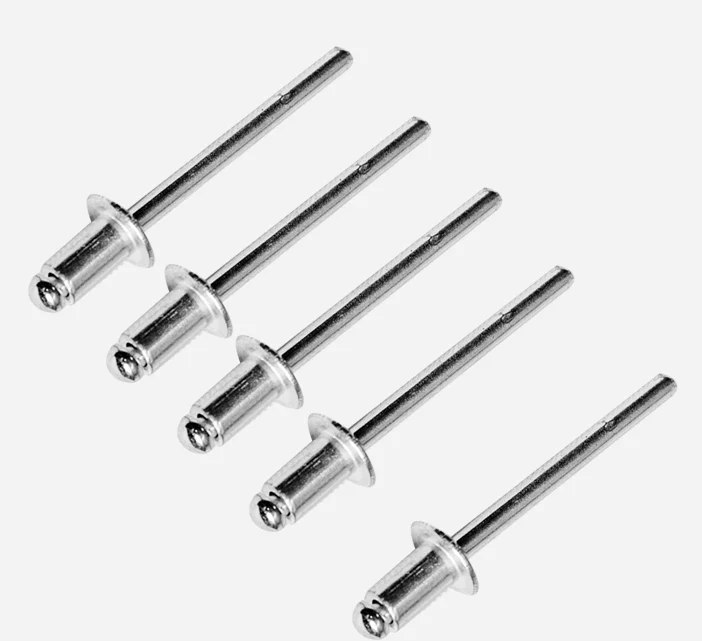
A blind rivet is a multi-component fastener, typically consisting of a tubular rivet body and a central stem, or mandrel, that runs through it. The mandrel is pre-installed within the rivet body and features a head that is larger than the rivet’s shank. During installation, the mandrel head is pulled into the rivet body, causing the blind end of the body to expand and form a second head, securing the joint.
Installation From One Side: The Key Advantage
Installing a blind rivet is a one-person job that requires a special tool known as a rivet puller or riveter. The process is straightforward:
- The blind rivet is inserted into the prepared hole.
- The nosepiece of the rivet puller is placed over the mandrel.
- Activating the tool pulls the mandrel, which expands the rivet body on the blind side, clamping the materials together.
- Once the joint is tight, the mandrel is designed to break off at a predetermined point, leaving a secure, locked fastener.
This single-sided accessibility is what makes blind rivets invaluable for areas like trailing edges of wings, inside enclosed fuselage sections, or during repairs where disassembling a major component is impractical.
Common Types of Blind Rivets in Aerospace
Not all blind rivets are created equal. In aerospace, high-strength, locking blind rivets are required. Common types include:
- CherryMAX® Rivets: A popular, high-strength structural blind rivet. Its locking mechanism ensures the remaining portion of the mandrel is mechanically locked into place, contributing to the fastener’s shear strength and preventing vibration-related issues.
- Huck-Clinch® Rivets: Another type of high-performance blind fastener used in demanding aerospace applications, known for excellent vibration resistance and high strength.
These are vastly superior to the common “pop” rivets used in non-structural applications, offering certified strength and reliability for aircraft use.
Head-to-Head Comparison: Solid Rivets vs. Blind Rivets
Choosing between a solid and blind rivet involves a trade-off between absolute strength and the practicalities of installation. The following table and explanations break down the key differences.
| Feature | Solid Shank Rivets | Blind Rivets |
|---|---|---|
| Strength (Shear & Fatigue) | Excellent. Solid cross-section provides maximum shear strength and fatigue life. | Good to Very Good. Generally lower than solid rivets, but structural versions are very strong. Strength depends on the locking mechanism. |
| Accessibility Requirement | Two-sided access is mandatory (one for rivet gun, one for bucking bar). | One-sided access only. Ideal for “blind” or enclosed areas. |
| Installation Speed | Slower, often requires two skilled technicians. | Faster, can be installed by a single technician. |
| Weight | Lighter per fastener due to simple, solid construction. | Slightly heavier due to the internal mandrel and locking collar components. |
| Cost per Fastener | Lower cost per unit. | Higher cost per unit due to complex manufacturing. |
| Inspection Method | Visual inspection of both the manufactured head and the formed shop head. | Visual inspection of the manufactured head and proper mandrel break-off. |
Strength and Fatigue Life: A Critical Distinction
A solid rivet’s strength is unparalleled because it creates a solid, one-piece fastener after installation. The shank swell provides a friction fit that helps carry the load and resist cyclical stresses, leading to excellent fatigue life. While structural blind rivets are incredibly strong, their strength is dependent on the integrity of their internal locking mechanism. The hollow nature of the rivet body (where the mandrel was) means they are generally not as robust in shear as a solid rivet of the same diameter and material.
Accessibility: The Deciding Factor in Complex Assemblies
This is the single most important reason for the existence of blind rivets. In modern aircraft, numerous locations—such as the inside of a wing box after it’s been sealed, deep within a tail cone, or for attaching interior components—make it physically impossible to get a bucking bar behind the fastener. In these situations, a blind rivet isn’t just an alternative; it’s the only viable solution.
Installation Speed and Skill Requirements
Installing solid rivets correctly is a skill that requires training and coordination between two technicians. In contrast, installing a blind rivet is a much faster and simpler process that can be performed by one person with minimal training. This can significantly reduce labor costs and assembly time, especially in repair scenarios or on complex assembly lines.
Inspection and Quality Assurance
Inspecting a solid rivet joint is straightforward: a trained inspector can visually check the condition of both heads and use a gauge to ensure the shop head is formed to the correct dimensions. For a blind rivet, inspection confirms that the head is seated correctly, the material is clamped, and the mandrel has broken off flush with the head as designed. This confirms proper installation, but the formation of the blind-side head remains unseen, relying on the proven reliability of the fastener’s design.
Making the Right Choice: Which Fastener for Which Application?
The selection process is dictated by the engineering blueprints and repair manuals, which are based on careful analysis of stress loads and accessibility.
When to Specify Solid Shank Rivets
Solid rivets are the default choice for the majority of an aircraft’s primary structure due to their superior strength-to-weight ratio and proven reliability. They are used in:
- Wing Spars and Ribs: The primary load-bearing components of the wings.
- Fuselage Seams and Stringers: The longitudinal joints and stiffeners that form the aircraft’s body.
- Pressurized Bulkheads: Areas that must withstand high differential pressure.
- Any joint where high shear strength and fatigue resistance are the top priorities and access to both sides is possible.
When Blind Rivets Are the Essential Option
Blind rivets are specified for areas where it is physically impossible to use a bucking bar, or where their speed offers a significant advantage in non-critical or secondary structures. Key applications include:
- Structural Repairs: Often used for patching skin or repairing components where disassembly is not feasible.
- Trailing Edges of Control Surfaces: These areas are often too thin or enclosed for a bucking bar.
- Attachment of Interior and System Components: Fastening brackets, clips, and panels inside the fuselage.
- Final “Close-Out” Assemblies: Installing the last few fasteners in an enclosed section of the airframe.
The Importance of Precision in Fastener Manufacturing
Whether it’s a simple solid rivet or a complex blind rivet, the performance of an aerospace fastener is directly tied to the precision of its manufacturing. The material composition, dimensional tolerances, and heat treatment must be exact. At rivetjl, we understand that safety and performance in industries like aerospace are built on a foundation of microscopic precision. While we specialize in high-quality molds for a variety of industries, our expertise is rooted in the same principles of tight tolerances, material science, and uncompromising quality control that define aerospace-grade components. This commitment to precision engineering ensures that every part, from a mold component to a critical fastener, performs its function flawlessly.
Conclusion: A Symbiotic Relationship in Modern Aircraft
Solid rivets and blind rivets are not competing technologies but rather complementary partners in aircraft construction and maintenance. Solid rivets provide the foundational strength and integrity for the core airframe, representing the pinnacle of simplicity and reliability. Blind rivets offer the versatility and ingenuity needed to solve complex assembly and repair challenges in tight spaces. Understanding the distinct advantages and applications of each allows engineers and technicians to build and maintain aircraft that are both incredibly strong and efficiently assembled, ensuring the highest levels of safety and performance in the skies.
Frequently Asked Questions (FAQ)
- Are blind rivets as strong as solid rivets?
- No. On a size-for-size basis, a solid rivet is generally stronger in shear and fatigue than a blind rivet. However, high-strength structural blind rivets like CherryMAX are engineered to meet specific, demanding load requirements and are perfectly safe and reliable when used in their designated applications.
- Can you replace a solid rivet with a blind rivet?
- Only if specified by an approved structural repair manual (SRM) or an engineering order. Because of the strength difference, a direct replacement is often not possible. Sometimes a larger diameter blind rivet must be used to achieve the required strength, but this is a decision for a qualified aerospace engineer.
- Why are solid rivets more common in aircraft than screws or bolts?
- Solid rivets offer an excellent strength-to-weight ratio, are relatively inexpensive, and are highly resistant to vibration once properly installed. The shank swelling during installation also provides a superior fit that prevents movement within the joint, enhancing fatigue life. Bolts are used in areas requiring higher tensile strength or where components need to be disassembled, but rivets are preferred for permanent joints.