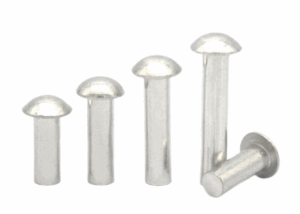
Solid rivets play a critical role in securing Electric Vehicle (EV) battery enclosures by providing a strong, permanent, and vibration-resistant fastening solution ideal for lightweight assembly. Their ability to join dissimilar materials without thermal distortion, coupled with high shear strength, makes them essential for ensuring the structural integrity, safety, and longevity of the battery pack, a core component of modern EVs.
The automotive industry’s seismic shift towards electrification has placed immense pressure on engineers to innovate at every level, from powertrain efficiency to chassis design. At the heart of this revolution is the battery pack—a heavy, complex, and vital component that demands an exceptionally secure and robust enclosure. As manufacturers relentlessly pursue lightweighting to maximize vehicle range and performance, traditional fastening methods are being re-evaluated. This is where the time-tested technology of solid rivets emerges as a superior solution, perfectly aligning with the stringent demands of EV battery enclosure assembly and lightweighting strategies.
This comprehensive guide explores the indispensable role of solid rivets in the EV landscape. We will delve into why these simple yet powerful fasteners are becoming the go-to choice for engineers, examining their mechanical advantages, their contribution to vehicle safety, and how they compare to alternative joining methods. For design engineers, manufacturing managers, and procurement specialists in the EV sector, understanding the benefits of solid riveting is key to building safer, lighter, and more reliable electric vehicles.
Table of Contents
- Why Do EV Battery Enclosures Demand Superior Fastening?
- The Champion of Lightweighting: How Solid Rivets Contribute
- Mechanical Advantages of Solid Rivets in EV Assembly
- Solid Rivets vs. Alternative Fastening Methods: A Comparative Analysis for EV Applications
- Material Compatibility: Solving the Dissimilar Materials Challenge
- The Critical Role of Solid Rivets in Safety and Thermal Management
- How to Choose the Right Solid Rivet for Your EV Application
- Partner with RivetJL for Your EV Fastening Needs
Why Do EV Battery Enclosures Demand Superior Fastening?
The EV battery enclosure, often called the “skateboard,” is far more than just a box. It’s a multi-functional, structural component that must perform under extreme conditions. Its primary function is to protect the sensitive battery cells from external impacts, moisture, and debris. However, it also contributes significantly to the vehicle’s overall chassis rigidity and crashworthiness. Any failure in the enclosure’s assembly can have catastrophic consequences, from loss of structural integrity to thermal runaway events. Therefore, the choice of fastener is not trivial; it’s a critical safety and performance decision.
Engineers face a triad of challenges when designing these enclosures: structural strength, environmental sealing, and weight reduction. The enclosure must withstand constant vibration from the road, twisting forces during vehicle maneuvers, and potential impacts from accidents. The fasteners holding it together must provide a permanent, unyielding joint that won’t loosen over the vehicle’s lifespan. Furthermore, as enclosures are often made from lightweight materials like aluminum alloys to offset the battery’s mass, the fastening method must be compatible and not compromise the material’s inherent strength.
The Champion of Lightweighting: How Solid Rivets Contribute
The mantra in the EV industry is “reduce weight, increase range.” Every gram saved contributes to better efficiency, performance, and a lower center of gravity for improved handling. Solid rivets are inherently lightweight fasteners, especially when manufactured from aluminum alloys. Their high strength-to-weight ratio means that engineers can achieve robust structural joints with minimal added mass compared to bulkier nuts and bolts or the added material required for certain welding processes.
More importantly, solid rivets enable the use of advanced lightweight materials. The cold-forming installation process, which involves no significant heat, allows for the secure joining of high-strength aluminum alloys, composites, and other materials that would be weakened or distorted by the high temperatures of welding. This “cold joint” capability is a game-changer, giving designers the freedom to use the most optimal, lightweight materials for the battery enclosure without being limited by their joining methodology. This directly supports the primary goal of lightweighting in EV design.
Mechanical Advantages of Solid Rivets in EV Assembly
Solid rivets are specified by aerospace and automotive engineers for a reason: they offer a unique combination of mechanical properties that are perfectly suited for dynamic, high-stress environments. Once installed, a solid rivet becomes an integral, permanent part of the structure.
Unmatched Shear and Tensile Strength
A properly installed solid rivet completely fills the hole (a phenomenon known as hole-fill), creating a friction-fit joint with immense clamping force. This configuration provides exceptional shear strength, which is the ability to resist forces acting parallel to the joint’s surface—a common stress in a vehicle chassis. The formed buck-tail on the rivet’s blind side, combined with the factory head, also delivers reliable tensile strength, resisting forces that try to pull the joint apart. This dual-axis strength is vital for an EV battery enclosure, which is subjected to complex, multi-directional loads during operation.
Exceptional Vibration Resistance
Perhaps the most significant advantage of solid rivets in an automotive context is their inherent resistance to loosening under vibration. Unlike threaded fasteners (screws and bolts), which can back out over time due to cyclical loads and thermal expansion/contraction, a solid rivet is a permanent, solid-state joint. There are no threads to strip or nuts to loosen. The complete hole-fill and clamping force create a joint that is virtually immune to the constant, high-frequency vibrations of a moving vehicle, ensuring the battery enclosure remains secure and rattle-free for life.
Ensuring Joint Integrity with Hole-Fill
During installation, the shank of the solid rivet expands radially to completely fill the pre-drilled hole before the buck-tail is formed. This 100% hole-fill is a critical feature. It eliminates any potential for movement or slippage between the joined sheets of material, creating a monolithic structure. This not only enhances the strength and vibration resistance but also improves the load transfer across the joint. It effectively makes the rivet a load-bearing part of the assembly, distributing stress evenly and preventing localized fatigue points that could lead to failure over time.
Solid Rivets vs. Alternative Fastening Methods: A Comparative Analysis for EV Applications
When selecting a joining method for EV battery enclosures, engineers evaluate several options. Here’s how solid rivets stack up against the common alternatives:
| Fastening Method | Pros for EV Enclosures | Cons for EV Enclosures | Best Use Case |
|---|---|---|---|
| Solid Rivets | High strength-to-weight ratio, excellent vibration resistance, no thermal distortion (cold process), cost-effective at scale, joins dissimilar materials. | Requires access to both sides, permanent (not designed for disassembly), requires specific installation tooling. | Permanent structural assembly of chassis and battery enclosure frames, especially with lightweight aluminum. |
| Welding (Spot/MIG/Laser) | Creates a continuous, sealed joint; strong; highly automatable. | Creates a Heat-Affected Zone (HAZ) that weakens aluminum alloys, risk of distortion, difficult with dissimilar materials, can be energy-intensive. | Sealing enclosure perimeters where material properties allow and a continuous joint is required. |
| Screws & Bolts | Allows for disassembly/serviceability, high clamping force, widely available. | Prone to loosening from vibration (requires thread-lockers), heavier, higher part count (nut, bolt, washer), slower assembly. | Attaching serviceable components, access panels, or mounting the battery pack to the chassis. |
| Blind Rivets | Installation from one side only, fast installation. | Generally lower shear/tensile strength than solid rivets, potential for water ingress if not sealed, core can vibrate. | Locations with blind access where structural load is lower. |
| Adhesives | Excellent for sealing, distributes load over a large area, can dampen vibration, joins dissimilar materials. | Requires extensive surface preparation, cure time can slow production, strength degrades at high temperatures, difficult to inspect joint quality. | Used in conjunction with other fasteners (rivet-bonding) for sealing and stress distribution. |
Material Compatibility: Solving the Dissimilar Materials Challenge
EV battery enclosures are often a cocktail of different materials. It’s common to see an aluminum frame, a steel mounting bracket, and composite covers all in one assembly. Joining these dissimilar materials is a major engineering hurdle. Welding them is often impossible, and using the wrong fastener can lead to galvanic corrosion—an electrochemical reaction that occurs when two different metals are in contact in the presence of an electrolyte (like road salt and water), causing one of the metals to rapidly corrode and fail.
Solid rivets provide an elegant solution. By selecting a rivet made from a compatible material (e.g., an aluminum rivet to join aluminum sheets) or by using a rivet with a protective coating, galvanic corrosion can be completely mitigated. The riveting process itself, being a mechanical interlock, doesn’t create the brittle intermetallic compounds that can form when welding dissimilar metals. This allows engineers to use the best material for each part of the enclosure without worrying about the integrity of the joints that hold them all together.
The Critical Role of Solid Rivets in Safety and Thermal Management
Beyond simple assembly, the choice of fastener has direct implications for vehicle safety and the performance of the battery’s thermal management system.
Maintaining Structural Integrity During Impact
The battery enclosure is a key part of the vehicle’s safety cage. In a collision, it must protect the battery cells from being punctured or crushed, which could lead to a dangerous thermal event. The high shear strength and ductility of solid rivets ensure that the joints will hold fast under extreme impact loads. Unlike a brittle weld that might crack, a riveted joint can often deform slightly without failing, absorbing crash energy and maintaining the enclosure’s protective structure. This predictable and reliable performance under duress is why rivets have been trusted in aircraft fuselages for decades and why they are now trusted in EV battery enclosures.
The Cold-Forming Advantage: No Heat-Affected Zones (HAZ)
Welding lightweight, heat-treated aluminum alloys (like the 6000-series common in EV structures) creates a Heat-Affected Zone (HAZ). In this zone, the heat from the welding process alters the metal’s crystalline structure, significantly reducing its strength and fatigue resistance. This means the material right next to the weld is much weaker than the parent material, creating a potential failure point. Solid riveting is a cold-forming process. The lack of high heat means there is no HAZ. The material properties of the aluminum sheets remain unchanged, ensuring that the assembly’s strength is consistent and predictable, a non-negotiable requirement for a safety-critical component like a battery enclosure.
How to Choose the Right Solid Rivet for Your EV Application
What is the best rivet for an EV battery enclosure? The selection depends on a few key factors:
- Material: The rivet material should be galvanically compatible with the materials being joined. Aluminum rivets (e.g., 5056 or 2117 alloy) are common for joining aluminum structures. Steel and stainless steel rivets are used where higher strength is required and materials are compatible.
- Head Style: A Universal Head (AN470) provides excellent strength and is a standard choice. A Countersunk Head (AN426) is used when a flush aerodynamic or cosmetic surface is required, such as on the enclosure’s underbody.
- Diameter and Length: The rivet’s diameter is determined by the required shear strength and the thickness of the material. A general rule of thumb is that the rivet diameter should be at least three times the thickness of the thickest sheet. The length must be sufficient to pass through the material stack with enough extra material to form a proper buck-tail (typically 1.5 times the rivet’s diameter).
- Required Strength: Engineers must calculate the shear and tensile loads the joint will experience and select a rivet material and diameter that exceeds these requirements with an appropriate safety factor.
Consulting with a fastener expert is crucial to ensure the optimal rivet is specified for your unique application. The right choice will guarantee a secure, lightweight, and durable assembly that meets all performance and safety standards.
Partner with RivetJL for Your EV Fastening Needs
The transition to electric mobility demands excellence in every component, and the fasteners that hold the vehicle together are no exception. Solid rivets offer a proven, reliable, and highly effective solution for securing EV battery enclosures and enabling lightweight assembly, directly addressing the core engineering challenges of strength, weight, and safety.
At RivetJL, we specialize in manufacturing high-quality solid rivets that meet the exacting standards of the automotive and aerospace industries. Our expertise in materials, head styles, and custom manufacturing can provide your engineering team with the perfect fastening solution for your next-generation electric vehicle. We understand the critical role our products play in your success.
Contact our engineering team today to discuss your application, request a quote, or learn more about how RivetJL solid rivets can help you build the future of transportation—securely, efficiently, and reliably.