Choosing between aluminum and stainless steel solid rivets in aerospace applications hinges on a critical balance of weight, strength, corrosion resistance, and temperature tolerance. As a general rule, aluminum rivets are the predominant choice for general airframe assembly, such as fastening skin panels and ribs, where their lightweight nature is paramount for fuel efficiency and payload capacity. Conversely, stainless steel rivets are indispensable and often mandated for high-stress, high-temperature, and corrosion-prone zones, including firewalls, engine nacelles, and exhaust areas, where structural integrity and heat resistance are non-negotiable. This guide provides an in-depth analysis to help engineers, A&P mechanics, and procurement specialists make an informed decision based on specific application requirements.
Table of Contents
- Understanding the Fundamentals: What Are Solid Aerospace Rivets?
- The Core Decision: Key Factors for Selecting Your Rivet Material
- Weight vs. Strength: The Primary Trade-Off in Aerospace Design
- Corrosion Resistance: Protecting Against Environmental Degradation
- A Special Note on Galvanic Corrosion: The Hidden Danger of Dissimilar Metals
- Temperature Tolerance: Performance Under Extreme Thermal Conditions
- Cost and Workability: Practical and Budgetary Considerations
- Comparative Analysis: Aluminum vs. Stainless Steel Rivets at a Glance
- Practical Applications: Where Are They Used on an Aircraft?
- Making the Right Choice: A Concluding Checklist
- RivetJL: Your Trusted Partner in Aerospace Fasteners
Understanding the Fundamentals: What Are Solid Aerospace Rivets?
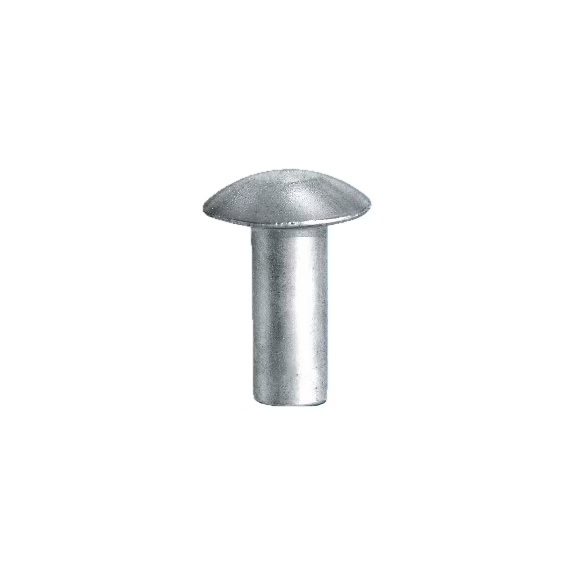
Before diving into material selection, it’s crucial to understand the role of solid shank rivets in aviation. Unlike blind rivets, a solid rivet is a permanent mechanical fastener consisting of a smooth, cylindrical shaft with a factory-formed head on one end. During installation, the tail end (bucktail) is deformed with a rivet gun and bucking bar, creating a second head (the “shop head”) that securely clamps the structural components together. This process, known as bucking, creates an incredibly strong and reliable joint that fills the hole completely, making it ideal for bearing and shear-load applications. In aerospace, these fasteners are not mere components; they are the fundamental elements that ensure the structural integrity of the entire airframe, from the fuselage skin to the wing spars. They are manufactured to exacting military (MS) and National Aerospace Standards (NAS) to guarantee performance and reliability.
The Core Decision: Key Factors for Selecting Your Rivet Material
The choice between aluminum and stainless steel is not arbitrary. It is a calculated engineering decision based on a multi-faceted analysis of the operational environment and structural demands of the joint. Each material offers a unique profile of advantages and disadvantages that must be carefully weighed.
Weight vs. Strength: The Primary Trade-Off in Aerospace Design
The most significant and often-debated factor is the strength-to-weight ratio. In an industry where every gram counts, material weight has a direct impact on fuel efficiency, range, and payload capacity. This is where aluminum shines. Aluminum alloys, such as the common 2117-T4 (AD) and 2024-T4 (DD) rivets, are approximately one-third the weight of stainless steel. This makes them the default choice for the vast majority of the aircraft’s structure, including fuselage skins, stringers, and ribs, where thousands of fasteners are used. Using aluminum massively reduces the overall weight of the aircraft without compromising the required strength for these specific applications.
On the other hand, stainless steel provides far superior shear and tensile strength. In applications subjected to intense vibration, heavy loads, or high stress, the robustness of steel is essential. Think of areas like engine mounts, landing gear assemblies, and control surface hinges. In these critical locations, the additional weight is a necessary trade-off for the increased strength and fatigue resistance needed to prevent catastrophic failure. The question to ask is: “What is the primary load this joint will experience?” If it’s a high-shear, high-tensile load, stainless steel is the safer and more reliable option.
Corrosion Resistance: Protecting Against Environmental Degradation
Aircraft operate in diverse and often harsh environments, from humid, salt-laden coastal air to de-icing chemicals on winter runways. Material choice is therefore critical for long-term durability. Aluminum naturally forms a passive, self-healing oxide layer that offers good corrosion resistance in many conditions. Common aerospace aluminum rivet alloys are specifically designed for this purpose. However, this protection can be compromised by certain chemicals or in highly corrosive environments.
Stainless steel, particularly alloys from the 300 series (like A286 or 302/304), offers exceptional corrosion resistance due to its chromium content (typically 18% or more). The chromium forms a robust, stable, and invisible passive film on the surface that is highly resistant to a wide range of corrosive agents. This makes stainless steel rivets the ideal choice for areas exposed to exhaust gases, hydraulic fluids, high moisture, or marine environments.
A Special Note on Galvanic Corrosion: The Hidden Danger of Dissimilar Metals
One of the most critical considerations when using different metals is the risk of galvanic corrosion. This electrochemical process occurs when two dissimilar metals are in electrical contact in the presence of an electrolyte (like moisture). The more active metal (anode) will corrode preferentially to protect the less active metal (cathode). When pairing rivets with sheet material, it is vital to consider their compatibility. Placing a stainless steel (more noble) rivet in an aluminum (more active) sheet creates a perfect scenario for galvanic corrosion, where the aluminum sheet around the rivet will rapidly degrade.
To mitigate this, engineers must follow strict protocols. When stainless steel rivets must be used in aluminum structures, they are typically installed “wet” with a corrosion-inhibiting primer (like zinc chromate) or sealant applied to the rivet and hole. This insulates the metals from each other. The golden rule is to use a fastener material that is as close as possible on the galvanic scale to the parent material. This is another reason why aluminum rivets are overwhelmingly used in aluminum structures.
Temperature Tolerance: Performance Under Extreme Thermal Conditions
The operational temperature range of a component is a deciding factor. Aluminum alloys begin to lose their strength significantly at elevated temperatures, typically above 250-300°F (121-149°C). This makes them entirely unsuitable for applications near the engine, exhaust systems, or within firewall structures designed to contain an engine fire.
This is where stainless steel is the only viable option. Corrosion-resistant steel (CRES) and other high-temperature steel alloys can maintain their structural integrity at temperatures well over 800°F (427°C), and in some cases, even higher. Therefore, for any application designated as a “firewall forward” or near high-temperature components, stainless steel rivets are mandated by FAA regulations and manufacturer specifications for safety and reliability.
Cost and Workability: Practical and Budgetary Considerations
From a procurement and installation perspective, there are practical differences. Aluminum is generally less expensive than stainless steel, which can lead to significant cost savings on a large-scale project involving hundreds of thousands of fasteners. Furthermore, aluminum rivets are much softer and easier to “drive” or “buck.” They require less force from the rivet gun, leading to faster installation and reduced fatigue for technicians. The softer 2117 (AD) rivets can be driven as-is, while the harder 2024 (DD) rivets require heat treatment and must be used within a short time frame, but they are still more workable than steel.
Stainless steel rivets are significantly harder and demand more powerful riveting tools and greater force to properly form the shop head. The installation process is slower and more physically demanding. This increased difficulty and the higher material cost make stainless steel a more specialized, application-specific choice rather than a general-purpose fastener.
Comparative Analysis: Aluminum vs. Stainless Steel Rivets at a Glance
To summarize the key decision-making factors, this table provides a direct comparison of the two materials across critical attributes.
| Attribute | Aluminum Rivets (e.g., 2117-T4, 2024-T4) | Stainless Steel Rivets (e.g., A286, 300 Series) |
|---|---|---|
| Weight | Low | High (approx. 3x aluminum) |
| Shear/Tensile Strength | Good to High | Excellent |
| Corrosion Resistance | Good (forms passive oxide layer) | Excellent (due to chromium content) |
| Max Service Temperature | Low (~250°F / 121°C) | High (800°F+ / 427°C+) |
| Workability/Installation | Easy (softer material, less force) | Difficult (hard material, requires more force) |
| Cost | Low to Moderate | High |
| Galvanic Compatibility | Excellent with aluminum sheets | Poor with aluminum sheets (requires insulation) |
Practical Applications: Where Are They Used on an Aircraft?
Understanding the properties is one thing; seeing where they are applied on a real aircraft solidifies the choice. The location on the aircraft is the ultimate guide to rivet selection.
Common Applications for Aluminum Solid Rivets
Given their excellent strength-to-weight ratio, aluminum rivets are the workhorse of the airframe. You will find them in:
- Fuselage Skin and Panels: Securing the vast surfaces of the aircraft’s outer body to the underlying frame (stringers and formers).
- Wing and Empennage Skins: Attaching the skin to the wing ribs and spars.
- Non-Structural Fairings: Fastening aerodynamic fairings that do not carry primary structural loads.
- Interior Structures: Assembling floor panels, cabin partitions, and other internal components where strength is needed but high temperatures are not a factor.
Critical Applications for Stainless Steel Solid Rivets
The superior strength and heat resistance of stainless steel reserve it for the most demanding and safety-critical locations:
- Firewalls: Forming the barrier between the engine compartment and the rest of the aircraft, where both fire resistance and structural strength are paramount.
- Engine Nacelles and Mounts: Securing components in the high-temperature, high-vibration environment of the engine housing.
- Exhaust System Shrouds: Fastening heat shields and ducting around hot exhaust components.
- Landing Gear Components: Used in high-stress points within the landing gear assembly that bear the full weight and impact forces of landing.
- Flight Control Surface Brackets: In high-load hinge points for ailerons, elevators, and rudders.
Making the Right Choice: A Concluding Checklist
When specifying or installing a solid rivet, ask the following questions to guide your selection between aluminum and stainless steel:
- What is the primary load? For general shear and tension in a weight-sensitive area, choose aluminum. For extreme loads, high vibration, or critical load paths, choose stainless steel.
- What is the operating temperature? If temperatures will exceed 250°F (121°C), stainless steel is the only option.
- What is the parent material? To prevent galvanic corrosion, match the rivet to the material. Use aluminum rivets for aluminum sheets. If you must use stainless steel in aluminum, have a mitigation plan (primer, sealant).
- What is the corrosive environment? For general use, aluminum is sufficient. For areas exposed to exhaust, chemicals, or salt spray, stainless steel offers superior protection.
- Is weight the primary driver? If the application is not temperature or strength-critical, always default to aluminum to save weight.
RivetJL: Your Trusted Partner in Aerospace Fasteners
The selection of the correct aerospace fastener is a matter of safety, performance, and longevity. At RivetJL, we understand the nuances that differentiate a simple component from a mission-critical part. We provide a comprehensive inventory of both aluminum and stainless steel solid rivets, all manufactured to the highest aerospace standards. Our expertise goes beyond supply; we are a resource for engineers and technicians, helping you navigate the complexities of material selection to ensure every joint is secure, compliant, and perfectly suited for its application. Contact us today to discuss your project’s specific requirements and find the ideal fastening solution.
solid rivets,
aluminum rivets,
stainless steel rivets,
aluminum vs stainless steel rivets,
aerospace rivet material selection,
choosing aerospace fasteners,
shear strength of aluminum rivets,
corrosion resistance of stainless steel rivets,
MS20470 rivets,
MS20426 rivets,
aircraft rivet guide,
galvanic corrosion in aircraft,
lightweight aircraft fasteners,
high-strength aerospace rivets,
firewall fasteners,
what are aerospace rivets made of,
when to use stainless steel rivets in aircraft,
solid shank rivets