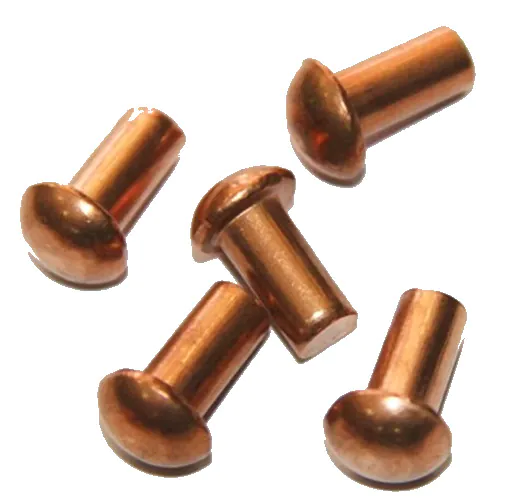
In high-vibration environments, solid rivets consistently outperform welding due to their inherent ability to create a strong, clamped joint that absorbs and dissipates vibrational energy. Unlike welding, which creates a rigid structure with a heat-altered, brittle zone prone to fatigue cracking, solid rivets maintain material integrity and provide superior long-term durability under cyclical stress. This makes them the premier engineering choice for critical applications in aerospace, bridge construction, and heavy machinery.
When selecting a joining method for structural components, engineers face a critical decision between thermal fusion (welding) and mechanical fastening (riveting). While both can create powerful bonds, their performance under dynamic loads—specifically constant vibration—is vastly different. Welding creates a single, monolithic piece, which sounds strong in theory. However, the intense heat required for this process creates a significant vulnerability: the Heat-Affected Zone (HAZ). This area of metal surrounding the weld becomes weaker and more brittle than the parent material. Under the relentless cyclical stress of vibration, microscopic cracks form in the HAZ and propagate over time, leading to sudden and often catastrophic fatigue failure.
Solid rivets, on the other hand, operate on a principle of immense clamping force. When a hot rivet is installed, it fills the hole completely and, as it cools, it contracts, pulling the joined plates together with tremendous pressure. This creates a joint where the load is transferred primarily through friction between the surfaces, not just the shear strength of the rivet itself. This clamped, multi-part assembly has a natural damping effect, allowing for micro-movements that safely dissipate vibrational energy instead of concentrating it at a single point of failure. This fundamental difference is why, for decades, industries that cannot afford failure have relied on the proven performance of solid rivets.
Table of Contents
- Understanding the Forces: Vibration, Fatigue, and Joint Failure
- Why Does Welding Struggle? The Achilles’ Heel of the Heat-Affected Zone (HAZ)
- How Do Solid Rivets Excel? The Secret Weapon of Clamping Force
- Head-to-Head Comparison: Solid Rivets vs. Welding
- Real-World Applications: Where Rivets are the Undisputed Champions
- Acknowledging the Role of Welding: When is it the Right Choice?
- Making the Right Choice: A Decision Framework for Your Application
- The RivetJL Advantage: Your Partner in High-Performance Fastening
Understanding the Forces: Vibration, Fatigue, and Joint Failure
To appreciate why riveting is superior for dynamic applications, one must first understand the primary enemy: metal fatigue. Fatigue failure doesn’t happen because a single force exceeds the material’s strength. Instead, it’s a gradual process of degradation caused by repeated or cyclical loading and unloading, such as the vibrations from an engine, airflow over a wing, or traffic on a bridge. Even if the stress from each cycle is well below the material’s ultimate tensile strength, these repeated forces create microscopic dislocations within the metal’s crystal structure. Over thousands or millions of cycles, these micro-cracks coalesce and propagate until the material’s remaining cross-section can no longer support the load, leading to abrupt failure.
The design of the joint is the single most important factor in determining its fatigue life. A perfect joint would distribute these cyclical stresses evenly across the entire structure. However, any feature that concentrates stress—known as a stress riser—becomes a nucleation point for fatigue cracks. Sharp corners, notches, and, critically, the abrupt change in material properties found in a welded joint are all classic examples of dangerous stress risers. The goal in a high-vibration environment is not just to create a strong joint, but to create a joint that actively manages and mitigates stress concentration.
Why Does Welding Struggle? The Achilles’ Heel of the Heat-Affected Zone (HAZ)
Welding is a process of metallurgical fusion. It melts the base metals and a filler material together to form what is, upon cooling, a single, continuous piece of metal. While this creates an incredibly strong static bond, the intense, localized heat fundamentally and permanently alters the material in the area surrounding the weld bead. This is the Heat-Affected Zone (HAZ).
What is the Heat-Affected Zone and Why is it a Problem?
The HAZ is a band of parent material that did not melt but was heated to a temperature high enough to change its microstructure. For steels and aluminum alloys, this often means a loss of ductility and an increase in brittleness. The carefully engineered properties of the original material—achieved through processes like heat treatment and work hardening—are effectively erased in the HAZ. This creates a distinct line of weakness. The joint is no longer a uniform material but a composite of three different zones: the ductile parent material, the cast structure of the weld itself, and the brittle, unpredictable HAZ sandwiched between them. It’s this transition zone that becomes the focal point for failure under vibration.
How Vibration Leads to Fatigue Cracking in Welds
The rigidity of a welded joint is its undoing in a dynamic environment. As the structure vibrates, all the stress is forced to travel through this rigid connection. The abrupt transition from ductile parent metal to the brittle HAZ acts as a powerful stress riser. Vibrational energy, instead of being dissipated, is concentrated directly on this weakened metallurgical line. Each vibration cycle flexes the joint, and the brittle HAZ is unable to deform elastically. Micro-cracks initiate at the toe of the weld—the point of highest stress concentration—and with each subsequent cycle, they grow deeper and longer, propagating through the HAZ until the joint fails completely and without warning.
How Do Solid Rivets Excel? The Secret Weapon of Clamping Force
A solid riveted joint functions on a completely different mechanical principle that is inherently more resistant to vibrational fatigue. Rather than fusing materials, rivets act as high-strength pins that generate an enormous clamping force, creating a joint that manages stress in a more intelligent way.
The Power of Clamping Force and Hole-Filling
The installation of a solid rivet is key to its performance. The rivet is heated to a specified temperature (typically around 1000°C / 1800°F for steel) and inserted into aligned holes. A bucking bar is held against the factory head while a pneumatic rivet gun forms the buck-tail on the other side. This process has two critical effects. First, the hot, malleable rivet expands to completely fill every microscopic void in the hole (a phenomenon known as hole-filling), leaving no room for movement or shear stress on the rivet shank itself. Second, as the rivet cools and contracts along its length, it exerts a massive clamping force on the plates it joins. This force is so great that it creates significant frictional resistance between the faying surfaces of the plates. In a well-designed joint, it is this friction that carries the majority of the load, not the rivet itself.
Energy Dissipation: A Rivet’s Secret Weapon
Unlike a rigid welded joint that concentrates stress, a riveted joint is designed to dissipate it. The multiple components—two plates and a rivet—allow for imperceptible micro-movements. This slight capacity for movement, combined with the friction between the clamped plates, provides a damping effect. Instead of vibrational energy building up at a single weak point, it is converted into a minute amount of heat and dissipated across the entire joint. This ability to “absorb” and safely release dynamic energy is the primary reason for a riveted joint’s vastly superior fatigue life in high-vibration scenarios.
No Thermal Stress, No Material Degradation
Perhaps the most straightforward advantage is that riveting is a non-thermal joining process for the parent materials. The plates being joined are not heated to a critical temperature. Their original strength, ductility, and grain structure remain entirely intact. There is no Heat-Affected Zone. There is no brittle transition line. The joint’s performance is predictable because the material properties are consistent and uncompromised, a critical factor for safety-focused industries.
Head-to-Head Comparison: Solid Rivets vs. Welding
To make an informed decision, it’s helpful to see a direct comparison across several key performance metrics. This table highlights the distinct advantages and disadvantages of each method, particularly in the context of demanding environments.
| Feature | Solid Rivets | Welding |
|---|---|---|
| Vibration Resistance | Excellent. Dissipates energy through clamping force and micro-movements, preventing stress concentration. | Poor. Rigid joint concentrates stress at the Heat-Affected Zone (HAZ), leading to fatigue. |
| Fatigue Life | Superior. Lack of a HAZ and the joint’s damping effect provide a very long life under cyclical loads. | Limited. The brittle HAZ is a natural nucleation point for fatigue cracks, drastically reducing lifespan. |
| Inspection | Simple & Visual. A loose or failed rivet is easily identified by visual inspection or simple tap testing. | Complex & Costly. Requires specialized NDT (Non-Destructive Testing) like X-ray or ultrasonic testing to find internal cracks. |
| Repairability | Straightforward. Failed rivets can be drilled out and replaced individually with minimal impact on the structure. | Difficult. Repairing a cracked weld often requires grinding out the entire old weld and HAZ, which can be complex and may weaken the area further. |
| Joining Dissimilar Materials | Excellent. Mechanically joins materials like aluminum to steel without issue, as there’s no metallurgical incompatibility. | Very Difficult / Impossible. Welding dissimilar metals often leads to galvanic corrosion or brittle intermetallic compounds. |
| Material Integrity | Preserved. The parent material’s properties are not altered by heat. | Compromised. The HAZ permanently alters and weakens the material’s microstructure. |
| Joint Type | Lap or Butt Joint (with strap plates). Creates a clamped, friction-based connection. | Butt, Lap, T, Corner. Creates a fused, monolithic connection. |
Real-World Applications: Where Rivets are the Undisputed Champions
The theoretical advantages of riveting are proven daily in some of the world’s most demanding engineering applications. These are not niche cases; they are foundational industries where reliability is non-negotiable.
Aerospace and Aviation
Why aren’t airplanes welded together? The answer is vibration and fatigue. An aircraft fuselage and wings are subjected to constant vibration from engines and turbulent airflow. A welded airframe would develop fatigue cracks with terrifying speed. Instead, aircraft skins are assembled using millions of solid rivets. They provide the necessary strength while allowing the structure to flex and dissipate energy, ensuring an incredible fatigue life and allowing for simple, reliable visual inspections before every flight.
Bridges, Buildings, and Infrastructure
Iconic structures like the Golden Gate Bridge, the Eiffel Tower, and countless railway bridges from the industrial era stand as testaments to the longevity of riveting. These structures endure daily cyclical loads from traffic, wind, and thermal expansion. The riveted joints allow the massive steel trusses to “breathe” and transfer loads effectively without concentrating stress, a feat that would be nearly impossible to achieve with welding over such a long service life.
Heavy Machinery and Automotive
The frames and chassis of heavy-duty trucks, construction equipment, and railway cars are prime examples of high-vibration environments. These vehicles’ frames must withstand constant shock and vibration from rough terrain and powerful engines. Solid riveting is often the preferred method for joining main frame rails and cross-members because it provides a durable, fatigue-resistant connection that can outlast the life of the machine itself.
Acknowledging the Role of Welding: When is it the Right Choice?
To maintain an expert and trustworthy perspective, it’s important to state that welding is an exceptional joining technology when used in the correct application. It is not an inherently inferior process, but rather one that is ill-suited for high-vibration environments.
Welding excels in situations where a rigid, monolithic, and often fluid-tight seal is required, and where dynamic loads are not the primary concern. Applications include:
- Pressure Vessels and Pipes: Welding provides a continuous, leak-proof seam essential for containing fluids and gases under pressure.
- Complex Geometries: Welding can be used to create intricate shapes and join components at odd angles that would be difficult or impossible to rivet.
- Static Structures: In buildings or structures not subject to significant vibration or cyclical loading, welding can be a faster and more cost-effective method for creating strong joints.
Making the Right Choice: A Decision Framework for Your Application
When choosing between riveting and welding, you are making a fundamental engineering decision about how your structure will manage stress over its lifetime. To guide your choice, ask these critical questions:
- What is the primary load type? Is it static (a constant weight) or dynamic (vibration, shock, cyclical)? If dynamic, lean heavily towards riveting.
- What is the expected service life and what are the consequences of failure? For critical, long-life applications where failure is catastrophic, the proven fatigue resistance of rivets is paramount.
- Will the joint need to be inspected regularly? Rivets offer simple, cheap, and reliable visual inspection. Welds require costly and specialized NDT.
- Are you joining dissimilar materials? If you need to join aluminum to steel, or other incompatible metals, riveting is the only practical solution.
- What is the operating environment? Will the joint be subjected to thermal expansion and contraction? A riveted joint is more forgiving of these movements.
The RivetJL Advantage: Your Partner in High-Performance Fastening
Ultimately, the choice to use solid rivets is a choice for long-term reliability, safety, and durability in the face of dynamic forces. It’s a method proven by over a century of success in the most demanding fields of engineering. Understanding the “why” behind this success—the dissipation of energy and the avoidance of heat-induced material degradation—is key to building structures that last.
At RivetJL, we don’t just supply fasteners; we provide the expertise that ensures your project’s success. With a comprehensive inventory of high-quality solid rivets in various materials and sizes, we are equipped to support industries from aerospace to historical restoration. Our commitment is to provide not only the components but also the knowledge to help you make the best fastening decisions for safety, longevity, and performance. Explore our product line or contact our team of experts to discuss your specific high-vibration application today.