Are you struggling with fasteners that are either too permanent or too weak for your project? Traditional rivets offer strength but no reusability, while other fasteners might lack the necessary security. Imagine a fastening solution that provides both robust connection and the flexibility for future disassembly and reassembly. This article will compare male-female rivets (reusable fasteners) with standard rivets, guiding you on when to choose the reusability and versatility of male-female systems for your specific applications.
Male-female rivets, also known as Chicago screws or binding posts, are reusable fasteners ideal for applications requiring periodic disassembly, adjustability, or a finished aesthetic on both sides, offering flexibility that standard (permanent) rivets cannot. Standard rivets provide a permanent, high-strength, tamper-proof joint for fixed assemblies.
At Jiliang Fastener Manufacturing, we’ve been crafting precision custom fasteners since 2008, understanding the diverse needs of global industries. Our expertise spans both permanent and reusable fastening solutions. Let’s explore the distinct characteristics of male-female rivets and standard rivets to help you make the optimal choice for your project.
Table of Contents
- What are Male-Female Rivets (Chicago Screws)?
- What are Standard (Permanent) Rivets?
- Key Differences: Male-Female vs. Standard Rivets
- Advantages and Disadvantages of Male-Female Rivets
- Advantages and Disadvantages of Standard Rivets
- Best Applications for Male-Female Rivets
- Best Applications for Standard Rivets
1. What are Male-Female Rivets (Chicago Screws)?
Have you ever needed to bind documents, create adjustable straps, or assemble items that might need to be taken apart later? Male-female rivets are often the answer. What exactly are they?
Male-female rivets, commonly known as Chicago screws or binding posts, are two-part threaded fasteners consisting of a male screw post and a female barrel post. They are designed for easy assembly and disassembly, making them ideal for reusable, adjustable, or modular applications.
Unlike traditional rivets that create a permanent joint, male-female rivets offer flexibility. The female barrel has an internal thread, and the male screw has an external thread that mates with it. At Jiliang Fastener Manufacturing, we produce these from various materials like brass, steel, and aluminum, often with decorative finishes. They are inserted through pre-punched holes in the materials, and then the male screw is threaded into the female barrel, creating a secure yet removable connection. This design is particularly valued in industries requiring adjustability, repairability, or a clean, finished look on both sides of the joined material.
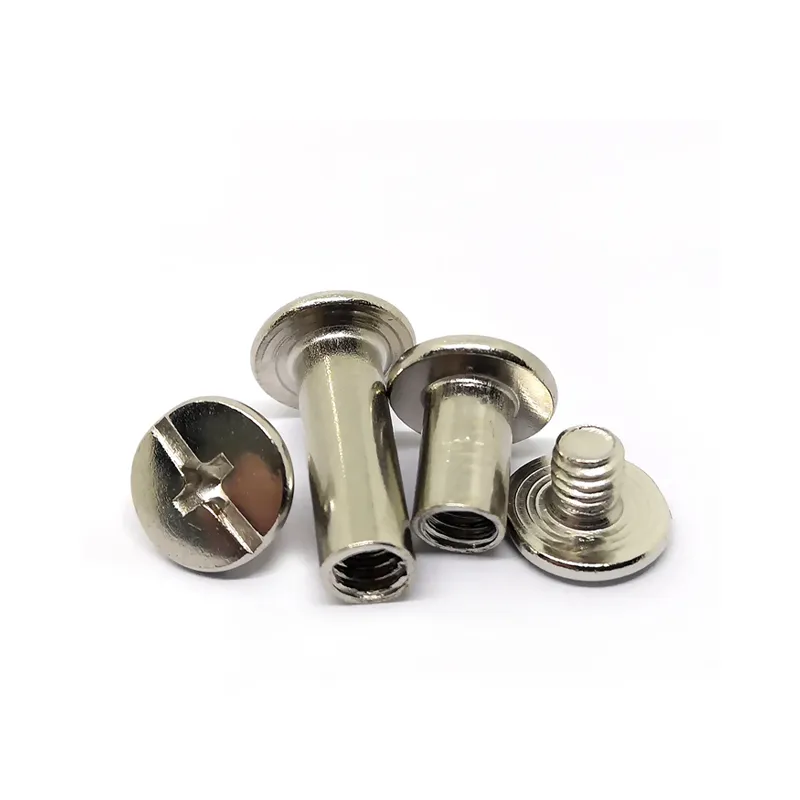
Components and Mechanism
A male-female rivet system consists of two primary components:
- Female Barrel (Post): This is a hollow cylindrical component with a cap on one end and an internally threaded shaft. It passes through the material layers.
- Male Screw (Post): This is a shorter component with a cap on one end and an externally threaded shaft that screws into the female barrel.
For example, in a leather belt, a Chicago screw might be used to attach the buckle, allowing the user to easily change buckles or adjust the belt length by unscrewing and re-screwing the fastener.
| Component | Description | Common Materials | Key Properties |
|---|---|---|---|
| Female Barrel | Hollow cylinder with internal thread | Brass, Steel, Aluminum, Zinc Alloy | Strength, internal threading |
| Male Screw | Shorter post with external thread | Brass, Steel, Aluminum, Zinc Alloy | Strength, external threading, head for driving |
The mechanism is simple: holes are punched in the materials, the female barrel is inserted, and the male screw is threaded into it. This creates a clamping force that holds the materials together. The caps on both ends provide a finished appearance. Jiliang Fastener Manufacturing ensures precise threading and durable materials for our male-female rivets, guaranteeing reliable and reusable connections for diverse applications.
Reusability and Adjustability
The defining characteristic of male-female rivets is their reusability. They can be easily unscrewed and reassembled multiple times without damaging the fastener or the joined materials. This makes them invaluable for products that require:
- Periodic Disassembly: For maintenance, cleaning, or component replacement. For instance, in custom furniture, male-female rivets might secure panels that need to be removed for access.
- Adjustability: To change the length, position, or configuration of components. Leather straps, binders, and modular displays often use these fasteners for this purpose.
- Modularity: To allow users to customize or upgrade parts.
This reusability offers significant advantages over permanent fasteners, reducing waste and increasing product lifespan. Jiliang Fastener Manufacturing’s male-female rivets are designed for consistent performance across multiple cycles of assembly and disassembly, providing flexibility and longevity for your products.
2. What are Standard (Permanent) Rivets?
When you need a connection that’s meant to last forever, standard rivets are often the go-to. But what defines them, and why are they considered permanent?
Standard rivets are mechanical fasteners that create a permanent, non-removable joint by deforming the rivet’s tail end during installation, forming a secure head that locks components together. They are ideal for high-strength, tamper-proof, and fixed assemblies where disassembly is not intended.
Unlike male-female rivets, standard rivets are designed for a one-time installation. They typically consist of a solid or semi-tubular shaft with a pre-formed head. At Jiliang Fastener Manufacturing, we produce these from various materials like steel, aluminum, and copper, tailored for specific strength and environmental needs. Once installed using a riveting tool, the tail end is upset or flared, creating a second head that permanently clamps the materials together. This method provides a robust, vibration-resistant joint, making them indispensable in industries from aerospace to construction where long-term structural integrity is paramount.
Types and Installation Mechanism
Standard rivets come in several types, each with a slightly different installation mechanism:
- Solid Rivets: These are the strongest type, requiring significant force to deform the entire solid shaft. They are installed by hammering or pressing the tail end to form a second head.
- Semi-Tubular Rivets: These have a partial hole at the tail, requiring less force to deform. The material rolls over to form a clinch.
- Blind Rivets (Pop Rivets): These can be installed from one side of the material, making them suitable for applications where access to both sides is limited. A mandrel is pulled through the rivet body, causing it to expand and form a blind head.
For example, in aircraft construction, solid rivets are used to join fuselage sections, creating a permanent, high-strength connection that can withstand extreme forces.
| Rivet Type | Installation Method | Key Characteristics |
|---|---|---|
| Solid Rivet | Hammering/Pressing | Highest strength, permanent |
| Semi-Tubular Rivet | Pressing/Flaring | Moderate strength, easier installation, permanent |
| Blind Rivet | Pulling Mandrel | Single-side access, permanent |
The mechanism of all standard rivets involves plastic deformation of the rivet material to create a permanent mechanical interlock. This process ensures a tight, vibration-resistant joint that is highly resistant to loosening. Jiliang Fastener Manufacturing produces a wide range of standard rivets, engineered for precise deformation and maximum joint integrity, ensuring reliable performance in permanent assemblies.
Permanence and Tamper Resistance
The defining characteristic of standard rivets is their permanence. Once installed, they cannot be easily removed without destroying the rivet itself, and often, without some damage to the joined materials. This makes them ideal for:
- Fixed Assemblies: Where components are not intended to be disassembled for the life of the product.
- Tamper-Proof Connections: Providing a secure seal against unauthorized access or alteration. This is crucial in security applications or for product warranties.
- High-Strength Structural Joints: Where the integrity of the connection is paramount and must withstand significant loads without loosening.
This permanence ensures long-term reliability and security, making standard rivets a cornerstone of many industrial and structural applications. Jiliang Fastener Manufacturing’s standard rivets are designed for maximum permanence and tamper resistance, providing robust and reliable solutions for critical fixed joints.
3. Key Differences: Male-Female vs. Standard Rivets
The choice between male-female and standard rivets hinges on fundamental differences in their design, installation, and intended use. What are these critical distinctions?
Male-female rivets are threaded, reusable, and designed for easy disassembly, offering flexibility and a finished look on both sides. Standard rivets are non-threaded, permanent, installed by deformation, and create a high-strength, tamper-proof joint not intended for removal.
These two fastener types serve distinct purposes, and understanding their core differences is paramount for selecting the appropriate solution for your application. The decision often comes down to whether permanence and ultimate strength are prioritized over reusability and aesthetic versatility.
Installation and Removal
The most obvious difference lies in their installation and removal.
- Male-Female Rivets: Installed by simply threading the male screw into the female barrel. Removal is just as easy – unscrew the male part. This process requires minimal tools (often just a screwdriver) and leaves both the fastener and the joined materials intact.
- Standard Rivets: Installed by deforming the rivet material (upsetting, flaring, or pulling a mandrel). This process creates a permanent mechanical lock. Removal typically involves drilling out the rivet, which destroys the fastener and can potentially damage the surrounding material.
| Feature | Male-Female Rivets | Standard Rivets |
|---|---|---|
| Installation | Threading | Deformation (hammering, pressing, pulling) |
| Removal | Easy (unscrew) | Difficult (drill out, destroy rivet) |
| Reusability | Yes | No |
| Joint Strength | Moderate (can loosen) | High (permanent) |
| Aesthetics | Finished on both sides | Finished on one side (often) |
| Tamper Resistance | Low | High |
For example, a male-female rivet might secure a leather strap that needs to be adjusted, while a standard rivet would permanently attach a structural bracket in a machine.
Joint Strength and Tamper Resistance
There’s a significant difference in the strength and tamper resistance of the resulting joint.
- Male-Female Rivets: Provide a secure joint, but because they are threaded, they can potentially loosen over time due to vibration or repeated stress. Their reusability also means they offer low tamper resistance; anyone with the right tool can remove them.
- Standard Rivets: Create a highly robust, permanent mechanical bond that is extremely resistant to vibration and loosening. Once set, they are tamper-proof, as removal requires destructive action. This makes them ideal for critical structural applications where security and unwavering strength are paramount.
Jiliang Fastener Manufacturing offers both types, allowing clients to choose based on whether their priority is flexibility and aesthetics (male-female) or ultimate strength and permanence (standard).
Aesthetic and Finish
The aesthetic outcome also differs.
- Male-Female Rivets: Typically feature finished caps on both the male and female components, providing a clean, polished, and symmetrical look on both sides of the joined material. This is often preferred in visible applications like leather goods or decorative items.
- Standard Rivets: While the manufactured head is finished, the formed (bucked or flared) tail end may not always be as aesthetically pleasing, especially with solid rivets. Blind rivets offer a cleaner finish on the blind side but still have a distinct head on the accessible side.
The choice here depends on whether a two-sided finished look is a design requirement. Jiliang Fastener Manufacturing provides a variety of finishes and head styles for both male-female and standard rivets to meet diverse aesthetic needs.
4. Advantages and Disadvantages of Male-Female Rivets
Male-female rivets offer unique benefits, but also come with specific limitations. Understanding these is key to their appropriate application.
Male-female rivets provide excellent reusability, adjustability, and a clean aesthetic on both sides, making them ideal for modular or repairable assemblies. However, they offer lower shear strength, can loosen over time, and are less tamper-resistant than permanent rivets.
Their design prioritizes flexibility and appearance, which makes them perfect for certain applications but unsuitable for others where ultimate strength and permanence are non-negotiable.
Key Advantages of Male-Female Rivets
Male-female rivets offer several compelling benefits:
- Reusability and Disassembly: This is their primary advantage. Components can be easily taken apart for maintenance, repair, cleaning, or replacement without damaging the fastener or the joined materials. This extends product lifespan and reduces waste.
- Adjustability: Ideal for applications where length, position, or configuration needs to be changed. Examples include adjustable straps, binders, and modular displays.
- Aesthetic Appeal: With finished caps on both the male and female parts, they provide a clean, polished, and symmetrical look on both sides of the joined material. This is highly valued in visible applications like leather goods, portfolios, and decorative items.
- Ease of Installation: Requires minimal tools (often just a screwdriver) and no special riveting equipment, making them accessible for DIY projects and small-scale production.
- No Special Tooling for Removal: Unlike standard rivets, removal doesn’t require drilling or destructive methods.
- Versatility: Can join a wide range of materials, including leather, fabric, paper, plastic, and thin metals.
Key Disadvantages of Male-Female Rivets
Despite their advantages, male-female rivets have limitations:
- Lower Shear Strength: Generally, they do not offer the same ultimate shear strength as a properly installed solid or semi-tubular rivet. The threaded connection can be a weaker point under extreme loads.
- Potential for Loosening: Over time, due to vibration, repeated stress, or improper tightening, the threaded connection can loosen. This may require periodic re-tightening.
- Lower Tamper Resistance: Since they can be easily unscrewed, they are not suitable for applications requiring a tamper-proof or highly secure connection.
- Not for High-Vibration Environments: Their threaded nature makes them less suitable for applications with constant or intense vibration, where standard rivets provide a more secure, vibration-resistant joint.
- Limited Clamping Force: While they provide a secure clamp, the maximum clamping force might be less than that achieved with a fully bucked solid rivet.
- Cost: Can sometimes be more expensive per unit than basic standard rivets, especially for high-volume applications.
Jiliang Fastener Manufacturing helps clients weigh these pros and cons to determine if male-female rivets are the optimal choice for their specific application, balancing flexibility with performance requirements.
5. Advantages and Disadvantages of Standard Rivets
Standard rivets are a cornerstone of permanent fastening, but their strengths and weaknesses dictate their appropriate use.
Standard rivets provide superior strength, high vibration resistance, and a permanent, tamper-proof joint, making them ideal for critical structural and fixed assemblies. However, they are non-reusable, require specialized installation tools, and can be difficult to remove without damaging the material.
Their design prioritizes an unyielding, long-lasting connection, which is essential for many industrial and structural applications but lacks the flexibility offered by reusable fasteners.
Key Advantages of Standard Rivets
Standard rivets offer several critical benefits:
- Superior Strength: When properly installed, solid and semi-tubular rivets provide extremely high tensile and shear strength, making them ideal for heavy-duty structural applications and critical load-bearing joints.
- Permanent Joint: Creates an unyielding, fixed connection that is not intended for disassembly. This ensures long-term structural integrity.
- High Vibration Resistance: The permanent mechanical interlock makes them highly resistant to loosening under vibration, unlike threaded fasteners. This is crucial in automotive, aerospace, and machinery applications.
- Tamper-Proof: Removal requires destructive action, making them suitable for security applications or where unauthorized access is to be prevented.
- Cost-Effective (for high volume): While requiring specialized tools, the rivets themselves can be very inexpensive in high volumes, making them economical for mass production.
- Wide Material Compatibility: Available in a vast array of materials (steel, aluminum, copper, stainless steel) to suit diverse strength, corrosion, and temperature requirements.
Key Disadvantages of Standard Rivets
Despite their robust advantages, standard rivets have limitations:
- Non-Reusable: Once installed, they cannot be removed without destroying the rivet and potentially damaging the joined materials. This makes them unsuitable for applications requiring maintenance, repair, or adjustability.
- Requires Specialized Tools: Installation typically requires dedicated riveting tools (rivet guns, presses, setters, anvils), which can be an initial investment and require operator skill.
- Difficult Removal: Removing a standard rivet is a destructive process, often involving drilling, which is time-consuming and can damage the surrounding material.
- Access Requirements: Most standard rivets (especially solid and semi-tubular) require access to both sides of the material for installation. Blind rivets overcome this but have their own strength limitations.
- Aesthetic (for some types): The formed tail end of some standard rivets (e.g., solid rivets) may not be as aesthetically pleasing as a finished cap, which can be a consideration for visible applications.
- Material Stress During Installation: The deformation process can induce stress in the surrounding material, which needs to be considered for delicate or brittle components.
Jiliang Fastener Manufacturing provides expert guidance on selecting the appropriate standard rivet type and material, ensuring optimal performance for permanent and critical assemblies.
6. Best Applications for Male-Female Rivets
Given their unique properties, male-female rivets excel in specific applications where reusability, adjustability, or a clean aesthetic are prioritized. Where are they the optimal choice?
Male-female rivets are best suited for applications requiring periodic disassembly, adjustability, or a finished aesthetic on both sides, including leather goods, binders, portfolios, modular displays, and custom apparel.
Their ability to create a secure yet removable connection makes them invaluable for products that need flexibility, repairability, or a refined appearance without the permanence of traditional rivets.
Leather Goods and Apparel
Male-female rivets are extremely popular in leathercraft and apparel due to their aesthetic appeal and reusability.
- Leather Goods: Used for attaching buckles to belts, securing straps on bags, creating adjustable closures on wallets, or joining multiple layers of leather where a clean finish on both sides is desired. For example, a Chicago screw allows a belt buckle to be easily swapped.
- Apparel: Found in custom clothing, denim, or accessories where decorative, yet functional, removable fasteners are needed. They can secure patches, embellishments, or adjustable elements.
| Industry/Application | Key Requirements | Specific Use Cases |
|---|---|---|
| Leather Goods | Reusability, aesthetic, adjustability | Belt buckles, bag straps, wallet closures |
| Apparel | Decorative, removable, adjustability | Custom clothing, patches, accessories |
| Binders/Portfolios | Reusability, document binding | Bookbinding, sample books, menus |
| Modular Displays | Disassembly, reassembly, flexibility | Retail displays, exhibition stands |
| Custom Furniture | Disassembly for transport/repair | Removable panels, adjustable components |
Binders, Portfolios, and Modular Displays
The reusability of male-female rivets makes them ideal for binding documents and creating modular structures.
- Binders and Portfolios: Commonly used as binding posts for custom books, sample swatches, menus, and portfolios, allowing pages to be added, removed, or rearranged easily.
- Modular Displays and Fixtures: In retail or exhibition settings, male-female rivets can be used to assemble display units that need to be frequently set up, taken down, or reconfigured. Their ease of assembly and disassembly saves time and labor.
Custom Furniture and Repairable Items
For items that might need future maintenance or customization, male-female rivets offer a practical solution.
- Custom Furniture: Can be used to secure panels or components that might need to be removed for access, transport, or repair, offering a more refined look than exposed screws.
- Repairable Items: Any product designed for user-level repair or component upgrades benefits from fasteners that can be easily removed and reinstalled.
Jiliang Fastener Manufacturing offers a wide range of custom male-female rivets in various materials and finishes, perfectly suited for these applications where flexibility and aesthetics are key.
7. Best Applications for Standard Rivets
Given their permanence and strength, standard rivets are the preferred choice for critical, fixed, and high-stress applications. Where do they truly excel?
Standard rivets are best suited for high-strength structural joints, permanent fixed assemblies, tamper-proof connections, and applications in high-vibration environments, including aerospace, automotive, construction, and heavy machinery.
Their ability to create an unyielding, long-lasting bond makes them indispensable in industries where fastener failure could lead to catastrophic consequences or where components are not intended for future disassembly.
Aerospace and Automotive (Structural)
In industries where safety and structural integrity are paramount, standard rivets are a cornerstone.
- Aerospace: Solid rivets (e.g., aluminum 2117-T4) are extensively used in aircraft fuselages, wings, and other primary structural components, providing high-strength, fatigue-resistant joints that can withstand extreme forces and vibrations.
- Automotive: Used in chassis assembly, engine components, and other critical structural parts where a permanent, vibration-resistant connection is essential for vehicle safety and performance.
| Industry/Application | Key Requirements | Specific Use Cases |
|---|---|---|
| Aerospace | High strength, fatigue resistance, permanent | Aircraft fuselages, wing structures |
| Automotive | High strength, vibration resistance, permanent | Chassis assembly, engine components |
| Construction | Structural integrity, permanence, tamper-proof | Bridges, building frameworks, heavy equipment |
| Heavy Machinery | High strength, vibration resistance, durability | Industrial equipment, agricultural machinery |
| Security/Tamper-Proof | Non-removable, secure | Security panels, product seals |
Construction and Heavy Machinery
For large-scale and robust applications, standard rivets provide the necessary durability.
- Construction: Used in bridges, building frameworks, and other large steel structures where permanent, high-strength connections are required to withstand environmental loads and ensure long-term stability.
- Heavy Machinery: In industrial equipment, agricultural machinery, and other heavy-duty applications, standard rivets secure components that experience significant stress, impact, and vibration, ensuring operational reliability.
Security and Tamper-Proof Applications
The non-removable nature of standard rivets makes them ideal for security.
- Security Panels and Enclosures: Used to permanently fasten access panels or enclosures where tampering or unauthorized removal is to be prevented.
- Product Seals and Warranties: Can be used to seal products, indicating if they have been opened or tampered with, thus preserving warranties or ensuring product integrity.
Jiliang Fastener Manufacturing specializes in custom standard rivets, engineered from various materials to meet the most stringent strength, durability, and security requirements of these critical industries.
Conclusion
The choice between male-female rivets and standard rivets is a fundamental design decision driven by your project’s specific needs. Male-female rivets offer unparalleled reusability, adjustability, and a clean aesthetic, making them ideal for leather goods, binders, and modular assemblies where flexibility is key. Conversely, standard rivets provide a permanent, high-strength, tamper-proof, and vibration-resistant joint, essential for critical structural applications in aerospace, automotive, and heavy construction.
At Jiliang Fastener Manufacturing, our expertise since 2008 in both permanent and reusable fastening solutions ensures we can guide you to the optimal choice. We understand that selecting the right rivet is crucial for the longevity, functionality, and security of your products. By carefully considering whether your application demands flexibility or unwavering permanence, you can make an informed decision that guarantees success. Contact us today to leverage our expertise and find the perfect fastening solution for your next project.