Looking to boost efficiency and cut costs on your production line? Slow fasteners create bottlenecks. Imagine a solution that speeds up manufacturing dramatically. This article explores why semi-tubular rivets are perfect for high-speed assembly, ensuring faster, more cost-effective production.
Semi-tubular rivets are ideal for high-speed assembly lines due to their partial hole design, which significantly reduces installation force. This enables rapid, automated setting with minimal material stress and consistent results.
At Jiliang Fastener Manufacturing, we’ve provided precision custom fasteners since 2008. We understand modern manufacturing demands and offer solutions for optimal efficiency. Let’s explore why semi-tubular rivets are a go-to for high-speed production.
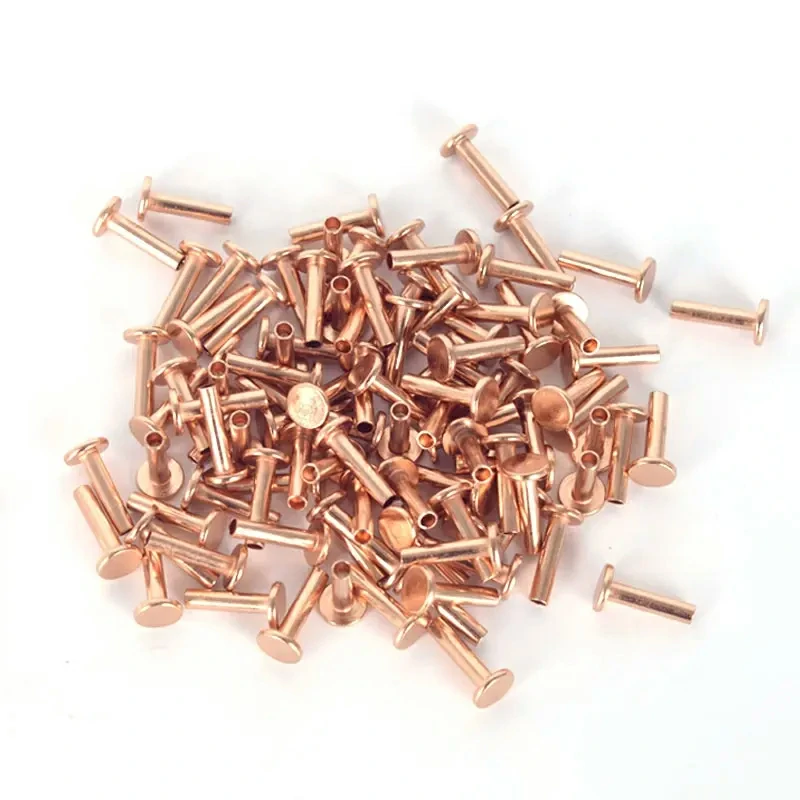
Table of Contents
- Understanding Semi-Tubular Rivets
- How Semi-Tubular Rivet Design Aids High-Speed Assembly
- Automation Benefits of Semi-Tubular Rivets
- How Semi-Tubular Rivets Reduce Assembly Costs
- Material and Application Versatility of Semi-Tubular Rivets
- Limitations of Semi-Tubular Rivets in High-Speed Assembly
1. Understanding Semi-Tubular Rivets
How do some fasteners balance secure connection with rapid installation? Understanding semi-tubular rivets’ design is key to their manufacturing role.
A semi-tubular rivet is a mechanical fastener with a partial hole at its tail end. This design allows for easier, less forceful deformation during installation, making it highly suitable for efficient, high-volume assembly.
These rivets feature a shallow hole from the tail, typically equal to the rivet’s diameter. Jiliang Fastener Manufacturing produces them in materials like steel, brass, and aluminum. The partial hole allows material to flare with less force, creating a secure clinch. This makes them perfect for automated riveting machines, driving efficiency in high-speed production.
Design and Material
The partial hole in a semi-tubular rivet acts as a controlled stress point, allowing predictable deformation with minimal force. For example, aluminum semi-tubular rivets secure delicate electronic devices without damage.
| Material Type | Common Applications | Key Properties for Assembly |
| Steel | Automotive, appliances | High strength, cost-effective |
| Aluminum | Electronics, lightweight assemblies | Lightweight, easy to deform |
Jiliang offers semi-tubular rivets in various materials and head styles (flat, oval, countersunk) for specific needs, ensuring seamless integration into high-speed assembly.
Installation Mechanism
Semi-tubular rivet installation relies on controlled deformation. Inserted into pre-drilled holes, a riveting machine applies pressure while an anvil supports the tail. The partial hole causes the material to flare outwards, creating a secure clinch. For instance, automated machines rapidly install these rivets in appliances for consistent quality.
This method is faster and requires less energy than solid rivets, reducing wear on equipment and minimizing material distortion. Jiliang ensures precise manufacturing for efficient, reliable installation, ideal for high-speed lines.
2. How Semi-Tubular Rivet Design Aids High-Speed Assembly
The unique design of semi-tubular rivets is crucial for high-speed assembly. How do these features lead to faster production?
The partial hole design of semi-tubular rivets significantly reduces the material volume needing deformation, leading to lower setting force, faster cycle times, and less stress on components and equipment, directly aiding high-speed assembly.
The ease of deformation in semi-tubular rivets is key. The partial hole acts as a pre-engineered weak point, allowing material to flare with minimal resistance. This makes the setting process quicker and less energy-intensive, achieving the rapid cycle times and consistent quality needed for automated production.
Reduced Setting Force and Cycle Time
The main benefit is the drastically reduced setting force. Riveting machines operate with less power and at higher speeds. For example, automated machines installing semi-tubular rivets can complete cycles much faster than with solid rivets, increasing parts processed per hour.
| Rivet Type | Setting Force Required | Typical Cycle Time (Automated) | Impact on Assembly Speed |
| Solid Rivet | High | Slower | Limits automation speed |
| Semi-Tubular Rivet | Low | Faster | Enables high-speed automation |
Lower setting force also reduces wear on equipment, extending lifespan and reducing downtime. Jiliang designs its semi-tubular rivets to optimize low-force deformation for maximum efficiency.
Minimized Material Stress and Damage
The semi-tubular design minimizes stress on joined components. Controlled deformation prevents excessive pressure, crucial for delicate materials like plastics or thin metals. For instance, in consumer appliances, semi-tubular rivets secure plastic housings without cracks.
Reduced material stress also ensures a cleaner, consistent joint appearance, important for visible components. This minimizes scrap and rework, boosting efficiency. Jiliang ensures optimal material compatibility, safeguarding product integrity.
3. Automation Benefits of Semi-Tubular Rivets
High-speed assembly relies on automation. What specific benefits do semi-tubular rivets offer for automation?
Semi-tubular rivets offer significant automation benefits, including seamless integration with automated riveting machines, consistent joint quality through repeatable processes, and reduced labor dependency, all crucial for maximizing efficiency and throughput on high-speed assembly lines.
Semi-tubular rivets are perfectly suited for automated feeding and setting. Their uniform shape and predictable deformation allow machines to operate with high precision and reliability, a cornerstone of modern high-speed manufacturing.
Seamless Integration with Automated Systems
Semi-tubular rivets are designed for easy feeding in automated systems. Their simple shape allows smooth feeding into machines without jamming, critical for continuous operation. For example, in automotive production, automated machines set hundreds of rivets per minute.
| Automation Feature | Benefit for Semi-Tubular Rivets | Impact on High-Speed Assembly |
| Vibratory/Bowl Feeding | Reliable, continuous supply | Eliminates manual loading |
| Automated Setting | Consistent force and deformation | Uniform joint quality |
Lower setting force allows for lighter, less complex automated machines, reducing footprint and energy. Jiliang ensures tight tolerances for compatibility with various automated riveting equipment.
Consistent Quality and Repeatability
Automated semi-tubular riveting provides unparalleled consistency. Machines apply precise, repeatable force, ensuring identical rivet setting. This eliminates variability from manual installation, leading to consistent joint strength and appearance, vital for product reliability in electronic enclosures.
This repeatability maintains high quality standards and reduces defects, leading to fewer rejects and less rework. Jiliang’s precision engineering ensures consistent performance in automated environments, delivering reliable, high-quality assemblies.
4. How Semi-Tubular Rivets Reduce Assembly Costs
Cost-effectiveness is key for high-speed assembly. How do semi-tubular rivets significantly reduce manufacturing costs?
Semi-tubular rivets reduce assembly costs through lower labor expenses due to automation, decreased tooling and energy costs from reduced setting force, and minimized material waste and rework, all contributing to more economical high-volume production.
The cost benefits of semi-tubular rivets go beyond purchase price. Their automated assembly process cuts expenses across manufacturing, optimizing economic efficiency for high-speed production.
Lower Labor and Tooling Costs
Significant savings come from reduced labor. Automation with semi-tubular rivets minimizes manual labor. One operator can oversee multiple machines, dramatically increasing output. For example, automating riveting in small appliances can cut labor costs by up to 70%.
| Cost Factor | Impact of Semi-Tubular Rivets | Cost Reduction Mechanism |
| Labor | Significantly reduced | Automation replaces manual labor |
| Tooling | Lower initial cost, longer lifespan | Less force, simpler machine design |
Lower setting force also means less wear on tools and machinery, extending lifespan and reducing maintenance. Machines can be simpler and less robust, lowering initial investment. Jiliang’s engineered rivets maximize tool life and minimize machine stress.
Minimized Material Waste and Rework
Consistent deformation of semi-tubular rivets reduces material damage. Fewer scrapped parts due to cracking or distortion. For instance, gentle setting prevents damage to sensitive circuit boards, cutting expensive material waste.
High repeatability in automated processes leads to fewer defects and less rework. Consistent quality means products pass inspections faster, avoiding costly repairs. Jiliang’s commitment to quality ensures lean production, minimizing waste and maximizing profitability.
5. Material and Application Versatility of Semi-Tubular Rivets
Beyond efficiency, semi-tubular rivets offer remarkable versatility. How does this adaptability benefit diverse high-speed assembly lines?
Semi-tubular rivets provide extensive material and application versatility, allowing them to join a wide range of materials, including dissimilar ones, and adapt to various product designs, making them a flexible and efficient fastening solution for diverse high-speed assembly lines.
The adaptability of semi-tubular rivets is a major asset for manufacturers with diverse product lines. Their ability to join different materials, often without pre-drilling, expands their utility across many industries. This versatility, combined with high-speed assembly, makes them invaluable.
Joining Diverse Materials
Semi-tubular rivets are highly versatile, joining metals, plastics, composites, and fabrics. This is useful where multiple materials are integrated. For example, in automotive, they attach plastic interior panels to metal frames.
| Material Type | Semi-Tubular Rivet Compatibility | Example Application |
| Metals (Steel, Aluminum) | Excellent | Appliance chassis |
| Plastics (ABS, Polycarbonate) | Very Good | Automotive interiors |
They can also join dissimilar materials, avoiding issues like galvanic corrosion. Jiliang offers custom semi-tubular rivets in various materials for optimal compatibility and robust connections.
Adaptability to Product Designs
Various head styles and shank lengths allow semi-tubular rivets to adapt to diverse product designs and aesthetics. Whether a flush surface (countersunk) or decorative finish (oval) is needed, there’s a design. For instance, decorative heads attach handles to luggage.
This adaptability extends to joining components of varying thicknesses. The flaring action accommodates a reasonable range of material stack-ups, simplifying design and reducing the need for specialized fasteners. Jiliang’s expertise ensures tailored semi-tubular rivets for any high-speed assembly application.
6. Limitations of Semi-Tubular Rivets in High-Speed Assembly
While efficient, semi-tubular rivets have limitations. What trade-offs should be considered for your production line?
Despite their efficiency, semi-tubular rivets have limitations in high-speed assembly, primarily lower structural strength and vibration resistance compared to solid rivets, making them unsuitable for critical load-bearing applications or environments with extreme dynamic forces.
Semi-tubular rivets compromise on ultimate strength for speed and cost. They are not a universal solution and must be chosen based on specific performance needs. Understanding these limitations prevents potential product failures.
Lower Structural Strength and Vibration Resistance
The main limitation is reduced structural strength. The partial hole creates a weaker cross-section, less resistant to extreme shear and tensile forces. This makes them unsuitable for primary load-bearing structures like aircraft wings.
| Performance Aspect | Semi-Tubular Rivet | Solid Rivet | Suitability for High-Stress Applications |
| Shear Strength | Moderate | Very High | Limited |
| Vibration Resistance | Good (but less than solid) | Excellent | Limited |
Semi-tubular rivets offer less resistance to loosening under extreme vibration than solid rivets. In high dynamic load environments, long-term integrity might be compromised, leading to fatigue failure. Jiliang advises assessing load and vibration for safety and durability.
Suitability for Specific Joint Thicknesses and Materials
Semi-tubular rivets’ effectiveness is limited by material thickness. Too thick, and the rivet may not clinch properly; too thin, and it might deform excessively. Correct rivet length and diameter are crucial.
While versatile, they may be suboptimal for extremely hard or brittle materials, where flaring can cause cracking. For perfectly flush surfaces on both sides, alternatives might be better. Jiliang’s expertise provides tailored recommendations for material properties and functional requirements.
Conclusion
Semi-tubular rivets are a powerhouse for modern manufacturing, blending efficiency and cost-effectiveness. Their partial hole design reduces installation force, enabling rapid, automated setting with minimal material stress, making them ideal for high-speed assembly lines. This leads to seamless automation, consistent quality, and significant cost reductions. While versatile, their limitations in ultimate structural strength and vibration resistance must be considered.
At Jiliang Fastener Manufacturing, our expertise since 2008 provides precision-engineered custom fasteners. We understand that the “ideal” fastener aligns perfectly with your application’s needs. Whether you prioritize maximum structural integrity or high-speed, cost-efficient assembly, our team helps you find the optimal solution. Contact us today to enhance your production line’s performance and profitability.