When comparing semi-tubular rivets vs solid rivets for fatigue resistance, solid rivets offer significantly superior performance. This is because solid rivets completely fill the hole during installation, creating a tight, interference fit that generates high clamp force and residual compressive stresses. These factors drastically reduce micro-movements within the joint, which are the primary cause of fatigue crack initiation and propagation. While semi-tubular rivets are faster and easier to install, their hollow shank acts as a natural stress concentrator, making them more susceptible to failure under cyclical loading. This article provides a comprehensive engineering breakdown of why solid rivets excel in high-fatigue environments, the specific mechanisms at play, and how to choose the right rivet for your application’s unique demands.
Table of Contents
- What Are Solid Rivets? A Foundation of Strength
- What Are Semi-Tubular Rivets? The High-Speed Solution
- The Core Question: Why Do Solid Rivets Have Superior Fatigue Resistance?
- A Head-to-Head Comparison: Solid vs. Semi-Tubular Rivets
- Beyond the Rivet: Critical Factors Influencing Joint Fatigue Life
- Making the Right Choice: When to Use Each Rivet Type
- Conclusion: Balancing Performance, Cost, and Application
- Partner with the Experts at rivetjl
What Are Solid Rivets? A Foundation of Strength
A solid rivet is the simplest and oldest type of mechanical fastener, consisting of a solid cylindrical shaft with a manufactured head on one end. As a permanent fastener, it is renowned for its exceptional strength and durability, particularly in shear and tension. Found in applications where structural integrity is paramount—from the Eiffel Tower to the fuselage of modern aircraft—solid rivets create some of the most reliable joints possible. Their simplicity is their greatest strength; with no complex geometry or inherent weak points, they provide a solid, uninterrupted cross-section for load transfer.
The Mechanics of Solid Rivet Installation
The installation of a solid rivet, known as bucking, is a process of controlled plastic deformation. The rivet is inserted into a drilled hole, and a bucking bar is held against the tail while a pneumatic rivet gun strikes the manufactured head. This high-energy impact causes the rivet’s shaft to swell, completely filling the hole—a phenomenon called hole-filling. Simultaneously, the tail of the rivet is upset, forming a second head (the bucktail or shop head) that is roughly 1.5 times the original shaft diameter. This process creates immense clamping force, squeezing the joined materials together and establishing a tight, rigid connection that is highly resistant to vibration and cyclical loads.
Key Advantages and Disadvantages of Solid Rivets
Advantages:
- Exceptional Fatigue Resistance: The tight interference fit and high clamp force are the primary reasons for its superior performance under cyclical stress.
- High Shear and Tensile Strength: The solid cross-section provides maximum material for resisting forces.
- Reliability and Permanence: Once installed correctly, a solid rivet forms an incredibly durable, permanent joint. Visual inspection is simple and effective.
- Cost-Effective Material: The fasteners themselves are often inexpensive to produce.
Disadvantages:
- High Installation Force Required: The process requires significant force and access to both sides of the assembly, making it unsuitable for delicate materials or confined spaces.
- Slower Installation Process: Bucking is a more labor-intensive and time-consuming process compared to other fastening methods.
- Skilled Labor Needed: Proper installation requires trained operators to ensure a secure joint and prevent damage to the surrounding material.
What Are Semi-Tubular Rivets? The High-Speed Solution
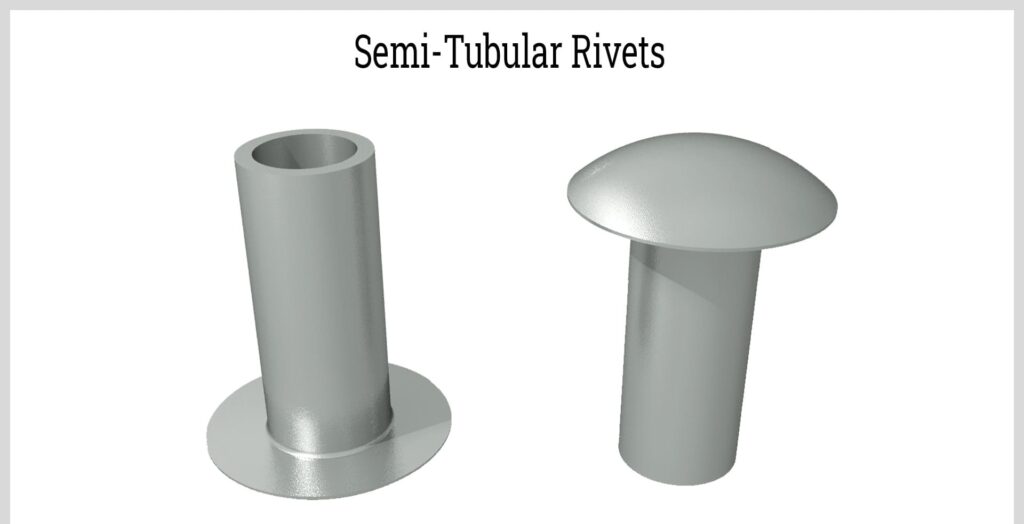
A semi-tubular rivet, as its name suggests, features a partially hollow shank. A shallow hole is drilled into the tail end of the rivet, with a depth typically not exceeding 112% of the shank diameter. This design modification is the key to its primary advantage: ease of installation. While still a permanent fastener, its purpose is to balance adequate joint strength with the demands of high-volume, automated, or force-sensitive manufacturing processes. They are ubiquitous in consumer electronics, automotive assemblies, HVAC systems, and luggage.
The Mechanics of Semi-Tubular Rivet Installation
Installing a semi-tubular rivet requires far less force than a solid rivet. The rivet is set into a hole, and a tool with a specific profile flares or rolls the tubular portion of the shank outwards against the material. This process, known as clinching, requires only about 25% of the force needed to buck a solid rivet of the same diameter. The material of the rivet tail curls over, securing the joint. This low-force installation makes it ideal for joining brittle materials like plastics or composites and for high-speed automated assembly lines where cycle time is critical.
Key Advantages and Disadvantages of Semi-Tubular Rivets
Advantages:
- Low Installation Force: Ideal for joining delicate, brittle, or thin materials without causing damage.
- Fast and Automated Installation: Perfectly suited for high-volume production lines, significantly reducing assembly time and cost.
- Versatility: Can be used as a pivot point in applications like scissors or folding mechanisms.
- Reduced Material Cost: The hollow section means slightly less material is used per rivet.
Disadvantages:
- Lower Fatigue Resistance: The hollow shank creates a stress concentration point, making it more prone to failure under vibration and cyclical loads.
- Reduced Shear and Tensile Strength: The reduced cross-sectional area means it cannot bear the same static loads as a solid rivet.
- Lower Clamp Force: The clinching process generates significantly less clamping force, which can allow for micro-movements in the joint.
The Core Question: Why Do Solid Rivets Have Superior Fatigue Resistance?
Fatigue failure in a mechanical joint is a progressive structural damage that occurs when a material is subjected to repeated or fluctuating stress cycles. The superiority of solid rivets in resisting this type of failure stems from the fundamental physics of their installation and final form within the joint. Three key factors work in concert to give solid rivets their exceptional fatigue life.
Hole Filling and the Power of Interference Fit
During installation, the shaft of a solid rivet expands radially to completely fill every microscopic void and irregularity in the hole. This creates an interference fit, where the rivet body is in a state of compression against the hole walls. This tight fit ensures that shear loads are transferred primarily through bearing and friction across the entire rivet-hole interface, rather than being concentrated at specific points. This uniform load distribution prevents localized stress build-up, which is a major precursor to the formation of fatigue cracks.
Clamp Force and Micro-Movement Prevention
The immense force used to form the bucktail creates a powerful clamping action, pulling the joined sheets of material together under high compressive force. This pre-loads the joint, significantly increasing the frictional forces between the faying surfaces. Why is this critical for fatigue? Because it prevents or drastically reduces fretting—the minute, abrasive movements between surfaces under load. Fretting is a notorious initiator of fatigue cracks. By locking the joint components together, the solid rivet effectively eliminates the conditions that allow fatigue to begin.
Stress Concentration: The Semi-Tubular Weakness
In contrast, the design of a semi-tubular rivet introduces an inherent weakness. The transition from the solid part of the shank to the hollow tail creates a sharp geometric change. In mechanical engineering, any such abrupt change in cross-section is a stress concentrator or stress riser. When the joint is subjected to cyclical loading, stress “flows” through the rivet, and it becomes amplified at this transition point. This concentrated stress makes it far easier for a microscopic crack to form and then propagate with each load cycle, leading to premature failure compared to a solid counterpart under the same conditions.
A Head-to-Head Comparison: Solid vs. Semi-Tubular Rivets
Choosing the right fastener requires a clear understanding of the trade-offs. The following table provides a direct comparison of the key attributes of solid and semi-tubular rivets.
| Attribute | Solid Rivets | Semi-Tubular Rivets |
|---|---|---|
| Fatigue Resistance | Excellent. High clamp force and interference fit prevent micro-movements. | Fair to Poor. Hollow shank acts as a stress concentrator. |
| Shear & Tensile Strength | Very High. Full-body cross-section for maximum load-bearing. | Moderate. Limited by the reduced cross-sectional area. |
| Installation Force | High. Requires bucking and access to both sides. | Very Low. Typically ~25% of the force needed for a solid rivet. |
| Installation Speed | Slow. Manual or semi-automated process. | Very Fast. Easily automated for high-volume production. |
| Ideal Materials | Metals, structural components. | Plastics, composites, leather, thin sheet metal, circuit boards. |
| Common Applications | Aerospace, bridges, boilers, heavy machinery, structural steel. | Electronics, automotive interiors, consumer goods, HVAC, luggage. |
Beyond the Rivet: Critical Factors Influencing Joint Fatigue Life
While the choice between solid and semi-tubular is a major first step, it is not the only variable that determines the fatigue life of a riveted joint. Several other factors play an equally important role, and overlooking them can negate the benefits of selecting the “stronger” rivet.
Material Selection (Rivet and Substrate)
The choice of material for both the rivet and the components being joined is critical. The rivet material should be strong yet ductile enough to be properly formed without cracking. Materials like aluminum alloys, steel, and titanium are common. It is also vital to consider galvanic compatibility between the rivet and the substrate materials to prevent corrosion, which can create pitting that acts as a starting point for fatigue cracks.
Joint Design and Hole Preparation
A well-designed joint distributes stress evenly. The spacing of rivets, the distance from the edge, and the thickness of the materials all influence performance. Furthermore, the quality of the hole is paramount. A clean, burr-free, and perfectly cylindrical hole ensures the rivet makes full contact and fills properly. A poorly drilled hole with rough edges can create its own stress risers, undermining the integrity of the entire joint.
The Unsung Hero: Installation Quality and Tooling
This is arguably the most critical factor. A perfectly designed joint with the best solid rivet can fail prematurely if installed incorrectly. Over-driving can damage the substrate material, while under-driving results in insufficient clamp force. This is where the quality of the installation equipment—from rivet guns to the custom molds and dies used to form the rivet heads—becomes essential. Precision tooling ensures that every rivet is set with consistent force and to the correct final geometry. Without high-quality tooling, achieving the theoretical fatigue resistance of a solid rivet is nearly impossible.
Making the Right Choice: When to Use Each Rivet Type
The decision is not simply about which rivet is “better,” but which is appropriate for the specific engineering and business requirements of your project.
Choose Solid Rivets for…
- High-Vibration Environments: Aerospace, engines, heavy industrial machinery.
- Structural & Load-Bearing Applications: Bridges, building frames, vehicle chassis.
- Safety-Critical Joints: Any application where joint failure would be catastrophic.
- Long-Term Durability Requirements: When the product is expected to last for decades under continuous stress.
Choose Semi-Tubular Rivets for…
- High-Volume, Automated Assembly: Consumer electronics, appliances, and automotive components where speed and cost are primary drivers.
- Joining Brittle or Thin Materials: Fastening plastics, circuit boards, or thin sheet metal where high installation force would cause cracking or deformation.
- Non-Structural Components: Attaching nameplates, brackets, and internal components where fatigue loading is minimal.
- Pivot Point Applications: Creating a simple, low-cost hinge in mechanisms like folding knives or casters.
Conclusion: Balancing Performance, Cost, and Application
In the direct comparison of semi-tubular rivets vs solid rivets, solid rivets are the undisputed champions of fatigue resistance. Their ability to create a high-strength, interference-fit joint with immense clamp force makes them the only choice for applications where structural integrity under cyclical loading cannot be compromised. However, this performance comes at the cost of slower, more forceful, and more skill-dependent installation.
Semi-tubular rivets, on the other hand, offer a brilliant solution for a different set of engineering problems. Their value lies in enabling rapid, low-cost, and automated assembly, especially with sensitive materials. Understanding this fundamental trade-off between ultimate performance and manufacturing efficiency is key to successful product design. The optimal choice is always the one that meets the specific fatigue, strength, and production requirements of your application without over-engineering the solution.
Partner with the Experts at rivetjl
Achieving optimal joint performance goes beyond selecting the right rivet. It requires a deep understanding of material science, joint design, and the precision manufacturing of components and tooling. At rivetjl, we specialize in creating high-precision molds and tooling that ensure every component of your assembly meets exact specifications. Whether you need custom fixtures for a riveting process or molds for complex components, our expertise guarantees the quality and consistency required for durable, reliable products. Contact us today to discuss how our manufacturing solutions can enhance the integrity of your next project.