The primary difference between DIN and ANSI rivet standards lies in their origin, unit of measurement, and dimensional tolerances. DIN (Deutsches Institut für Normung) is a German standard based on the metric system (millimeters), widely used in Europe, while ANSI (American National Standards Institute) is a U.S. standard primarily using the imperial system (inches). This distinction critically impacts design, manufacturing, and global supply chain logistics, making a thorough understanding essential for sourcing the correct fasteners for your application.
In today’s globalized marketplace, sourcing components like rivets often means navigating a complex web of international standards. For engineers, procurement managers, and product designers, the choice between DIN and ANSI is not merely a matter of preference—it’s a critical decision that affects product assembly, supply chain reliability, and cost-effectiveness. Misunderstanding these standards can lead to costly errors, production delays, and incompatible parts. This comprehensive guide will demystify the differences between DIN and ANSI, explore their practical implications, and provide a strategic framework for making the right sourcing decisions for your business. At RivetJL, we specialize in helping our clients navigate these complexities, ensuring you get the right rivet, to the right specification, every time.
Understanding the Standards Bodies: Who are DIN and ANSI?
Before diving into a direct comparison, it’s crucial to understand the organizations behind these acronyms. They are not just collections of documents; they represent decades of engineering consensus, regional manufacturing practices, and distinct industrial philosophies.
What is DIN (Deutsches Institut für Normung)?
The Deutsches Institut für Normung, or German Institute for Standardization, was founded in 1917. As its name suggests, DIN is the German national standards body. Its specifications are renowned for their precision, detail, and rigorousness. Because of Germany’s powerful role in European manufacturing and engineering, DIN standards are highly influential and widely adopted across Europe and in many other parts of the world. Key characteristics of DIN standards include:
- Metric System: All dimensions, tolerances, and specifications are defined in metric units (millimeters, newtons, etc.).
- European Dominance: It is the de facto standard for many industries operating in or sourcing from Europe.
- Transition to ISO: Many DIN standards have been, and continue to be, harmonized or replaced by international ISO standards (e.g., DIN 9021 is now largely covered by ISO 7093). However, many “old” DIN numbers remain common parlance in the industry.
What is ANSI (American National Standards Institute)?
The American National Standards Institute was founded in 1918. Unlike DIN, ANSI does not develop standards itself. Instead, it oversees and accredits the development of standards by other organizations, such as the American Society of Mechanical Engineers (ASME) and the Industrial Fasteners Institute (IFI). ANSI standards therefore represent a consensus across various U.S. industries.
- Imperial System: ANSI standards traditionally use the United States customary units, or the imperial system (inches, pounds-force, etc.).
- North American Influence: It is the dominant standard in the United States, Canada, and regions with strong U.S. manufacturing ties.
- Broad Consensus: As an accrediting body, ANSI ensures that standards like those for rivets (e.g., ASME B18.1) are developed with input from a wide range of stakeholders.
The Role of ISO (International Organization for Standardization) as a Global Bridge
No discussion of DIN and ANSI is complete without mentioning ISO (International Organization for Standardization). ISO aims to create a single set of globally accepted standards to facilitate international trade and collaboration. Many DIN and ANSI standards have direct or near-direct ISO equivalents. The ultimate goal is for ISO to serve as a universal language for engineering. However, the transition is slow, and for decades to come, legacy systems, existing tooling, and regional preferences mean that engineers and buyers must remain fluent in all three systems.
The Core Differences: A Head-to-Head Comparison of DIN and ANSI Rivet Standards
While both standards aim to create reliable and consistent fasteners, their methodologies differ in key areas. These differences are not academic; they have real-world consequences for fit, performance, and interchangeability.
Unit of Measurement: The Metric vs. Imperial Divide
This is the most fundamental difference. DIN uses the metric system. A rivet’s diameter might be specified as 4.8 mm. ANSI uses the imperial system, specifying the same dimension in fractional or decimal inches, such as 3/16″ (which converts to approximately 4.76 mm). This small difference of 0.04 mm might seem trivial, but in applications requiring precise hole sizes and tight clearances, it can be the difference between a perfect fit and a failed joint. Direct conversion is rarely a safe assumption.
Dimensional Tolerances and Fit
Beyond the base unit, the acceptable range of variation—the tolerance—often differs. German engineering, reflected in DIN standards, is often associated with tighter tolerances on specific dimensions to ensure a precise fit. ANSI standards may prioritize different aspects, sometimes allowing for slightly looser tolerances that can facilitate faster automated assembly. This means that even if a DIN and an ANSI rivet have a nearly identical *nominal* diameter, their maximum and minimum allowable diameters might not overlap, leading to interference fits (too tight) or loose connections.
Material Specifications and Strength Grades
How the strength and composition of a rivet’s material are specified also varies. DIN standards typically refer to material standards like DIN 1654 for steel wire or use specific material numbers (e.g., AlMg5 for an aluminum-magnesium alloy). ANSI standards reference material grades from organizations like ASTM (American Society for Testing and Materials) or SAE (Society of Automotive Engineers). While equivalent materials often exist, their chemical compositions and mechanical properties (like shear and tensile strength) may not be identical. Certifications and material traceability documentation will follow these different systems, a crucial point for regulated industries like aerospace and automotive.
Head Styles, Shank Diameters, and Grip Ranges
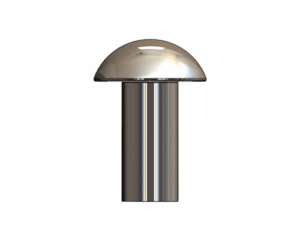
The geometry of the rivet itself can vary. While common head styles like dome, countersunk, and large flange exist in both systems, their specific proportions—head diameter to shank diameter ratio, head height, and countersink angle—can differ. For example, a standard DIN countersunk rivet may have a 90° or 120° angle, while an ANSI equivalent might be 100°. Using the wrong one can result in improper seating and a weak or cosmetically flawed joint.
| Feature | DIN Standard | ANSI Standard | Key Sourcing Consideration |
|---|---|---|---|
| Unit of Measurement | Metric (millimeters) | Imperial (inches) | Direct conversion is imprecise; always use the native unit for design and procurement. |
| Dimensional Tolerances | Often specifies tighter tolerances on certain dimensions. | Tolerances may be different, sometimes optimized for automated assembly. | Verify if tolerance ranges overlap for potential substitutes. Mismatches can cause fitment issues. |
| Material Designation | References DIN or ISO material numbers (e.g., AlMg3, St34). | References ASTM or SAE material grades (e.g., Grade 2 Steel, 5052 Aluminum). | Ensure material certificates match the required standard. Functional equivalence requires engineering approval. |
| Head Geometry | Specifies distinct head ratios and angles (e.g., 120° countersink). | Specifies different head ratios and angles (e.g., 100° countersink). | Using the wrong head geometry will lead to improper seating and compromised joint integrity. |
Practical Implications for Global Sourcing and Manufacturing
Understanding these technical differences is only half the battle. The real challenge lies in managing their impact on your business operations. Choosing a standard, or mixing them, has far-reaching consequences.
Why Your Choice of Standard Matters for Your Supply Chain
Your choice of standard dictates your pool of potential suppliers. If your drawings specify DIN-standard rivets, you will find the most competitive pricing and shortest lead times from European and many Asian suppliers. If you specify ANSI, North American suppliers will be your primary source. Attempting to source ANSI rivets from a predominantly DIN-focused factory (or vice-versa) can lead to longer lead times, higher costs due to custom tooling, and an increased risk of quality-control errors.
Cost, Availability, and Lead Time Considerations
Generally, it is most cost-effective to design with the standard that is most common in your region of manufacturing. For manufacturing in the EU, using DIN rivets means tapping into a vast, established supply chain. For manufacturing in the USA, ANSI is the path of least resistance. Forcing a US-based factory to use a niche DIN rivet can inflate costs and create a single-source dependency, while asking a German plant to import ANSI fasteners can add transportation costs and customs delays.
Ensuring Compatibility and Interchangeability in Global Assemblies
Consider a product designed in the United States (using ANSI) but assembled in both Mexico (ANSI-prevalent) and Poland (DIN-prevalent). This is a common scenario. If a DIN rivet is substituted for an ANSI rivet in the Polish factory without proper engineering review, the result could be a subtly weaker product. This creates a dangerous lack of uniformity. True interchangeability is rare and must be validated through rigorous testing, not just by looking at a conversion chart. A “functionally equivalent” part is an engineering determination, not a procurement assumption.
Common Rivet Standards in Focus: DIN vs. ANSI Equivalents
Let’s examine a tangible example to make these differences concrete. The blind rivet is one of the most common fasteners worldwide.
Blind Rivets: Comparing DIN 7337 and ANSI B18.7
DIN 7337 is the German standard for break-mandrel blind rivets. ANSI B18.7 is the U.S. equivalent. A manufacturer looking for a 4.8mm x 12mm DIN 7337 rivet might be told a 3/16″ x 1/2″ ANSI B18.7 rivet is “the same.” However, a closer look reveals key differences:
- Diameter: A 4.8mm DIN rivet has a recommended hole size of 4.9-5.0mm. A 3/16″ (4.76mm) ANSI rivet has a recommended hole size of 0.192″-0.196″ (4.88-4.98mm). The slight mismatch can affect the shear strength and clamp-up of the joint.
- Grip Range: The specified effective grip ranges for a given length of rivet may differ between the standards. Using the wrong one can result in a failed setting where the mandrel breaks too early or too late.
- Head Dimensions: The dome head profile and diameter-to-shank ratio are not identical, affecting bearing surface area.
In our experience at RivetJL, while these rivets can sometimes be used interchangeably in non-critical applications, it is a risk. For any structural or high-vibration application, such a substitution must be formally approved by the design engineer.
What to do when a direct equivalent doesn’t exist?
This is a common challenge. The best course of action is to partner with a knowledgeable supplier. The solution is not to find a non-existent “exact” cross, but to identify a functionally equivalent part. This involves providing your supplier with the full application details: hole size, clamped material thickness (grip), required shear and tensile strength, materials being joined, and any environmental considerations. An expert can then recommend a suitable rivet from the available standard (be it DIN, ANSI, or ISO) that meets or exceeds all critical performance parameters, even if its nominal dimensions aren’t an exact match.
How to Choose the Right Rivet Standard for Your Project
Making a strategic decision requires a methodical approach. Follow these steps to minimize risk and optimize your supply chain.
Step 1: Analyze Your Primary Market and Manufacturing Location
Where will your product be sold and serviced? If it’s primarily North America, using ANSI standards ensures that repair parts will be readily available. Where will it be manufactured? Aligning your design standard with your manufacturing location’s dominant standard will almost always result in lower costs and better availability.
Step 2: Review Your Engineering Drawings and Legacy Specifications
For new products, you have a choice. For existing products, you are often bound by legacy drawings. If your company has a library of ANSI-based designs, switching to DIN for a new project requires a compelling reason. Consistency reduces errors and simplifies inventory management. If you must integrate a part from a different standard, ensure the drawing is updated to clearly specify all critical parameters and tolerances for inspection.
Step 3: Consult with Your Rivet Supplier for Expert Guidance
This is the most critical step. Your rivet supplier is not just a vendor; they are a technical resource. A knowledgeable partner like RivetJL can look at your application and provide invaluable advice. We can identify potential sourcing risks, suggest cost-saving alternatives, and validate whether a proposed substitute is functionally viable. Don’t make the decision in a vacuum—leverage the expertise available to you.
Partnering with RivetJL for Seamless Global Sourcing
Navigating the nuances of DIN, ANSI, and ISO standards is our specialty. We don’t just sell rivets; we provide fastening solutions built on a foundation of deep technical expertise and global sourcing experience.
Our Expertise in Both DIN and ANSI Standards
At RivetJL, our team is fluent in the language of both DIN and ANSI. We understand the subtle but critical differences in their specifications, material callouts, and performance characteristics. We maintain a robust supply chain with manufacturing partners who are experts in producing to either standard, ensuring that we can source the exact part your design requires, without forcing a risky substitution.
How We Bridge the Gap for Our Customers
Our value lies in being the bridge between standards. When a customer comes to us with an ANSI drawing for a product being made in Asia, we know exactly how to translate those requirements to our DIN-centric partners, ensuring all critical-to-quality dimensions and material properties are met. We manage the technical translation and quality assurance so you don’t have to. This proactive approach prevents costly mistakes and delays down the line.
Request a Quote for Your Specific Rivet Needs
Whether your drawings call for DIN 7337, ANSI B18.7, or a custom specification, our team is ready to assist. We can provide technical guidance, confirm the best standard for your application, and deliver a competitive quote for high-quality rivets that meet your exact needs. Don’t let standards confusion compromise your product. Contact RivetJL today to partner with the experts in global rivet sourcing.