The Ultimate Guide to Screw Production: From Workflow to Mold Design
The complete screw production workflow is a sophisticated, multi-stage manufacturing process that transforms raw metal wire into a finished fastener through precision engineering. This journey involves several key stages, including wire preparation, cold heading, thread rolling, heat treatment, and surface finishing. Central to this entire operation is the expert design of the tooling and dies—often mistakenly called “molds”—which are meticulously engineered to shape the metal at each step with incredible accuracy and strength. Understanding this synergy between the production workflow and tooling fundamentals is crucial for anyone involved in engineering, manufacturing, or sourcing high-quality fasteners.
Table of Contents
- Understanding the Core Concepts: What is Screw Manufacturing?
- The Step-by-Step Screw Production Workflow
- Stage 1: Raw Material Preparation – The Foundation of Quality
- Stage 2: Cold Heading – Forging the Screw’s Head
- Stage 3: Threading – Creating the Helical Grip
- Stage 4: Heat Treatment – Engineering the Screw’s Strength
- Stage 5: Surface Finishing & Plating – Protection and Aesthetics
- Stage 6: Quality Control & Sorting – Ensuring Perfection
- Deep Dive into Screw Mold (Tooling & Die) Design Fundamentals
- Partnering with the Right Manufacturer: What to Look For
- Conclusion: The Symphony of Precision in Screw Manufacturing
Understanding the Core Concepts: What is Screw Manufacturing?
Before diving into the production line, it’s essential to grasp the foundational principles that make modern screw manufacturing possible. The vast majority of screws are not created by cutting away material but by forming it under immense pressure. This distinction is critical for understanding the quality, strength, and cost-effectiveness of the fasteners you use every day.
The Distinction: Machining vs. Cold Forming
There are two primary methods for manufacturing screws: machining (subtractive) and cold forming (formative). Machining, or turning, involves starting with a metal rod of the screw’s final diameter and using a lathe to cut away material to create the threads and head. While excellent for small batches, prototypes, or highly specialized geometries, it is slower, generates significant waste (scrap metal), and can compromise the material’s strength by cutting through its natural grain structure.
Cold forming, which includes cold heading and thread rolling, is the dominant method for mass-producing screws. This process starts with a wire of a smaller diameter and uses a series of high-pressure strikes and rolling operations to form the metal into the final screw shape at room temperature. This method is incredibly fast, produces virtually no waste, and, most importantly, enhances the screw’s strength. By forcing the metal’s grain to flow along the contours of the head and threads, cold forming creates a finished product that is significantly stronger and more fatigue-resistant than a machined equivalent.
Why “Mold Design” is Actually “Tooling & Die Design” in Screw Production
In the fastener industry, a common point of confusion is the term “mold.” While the concept is similar—creating a cavity to shape a material—the term mold is technically reserved for processes like plastic injection molding or liquid metal casting. For producing screws via cold forming, the correct terminology is tooling and dies. This set includes hardened steel or tungsten carbide components like heading dies, punches, cutoff knives, and thread rolling dies. These tools are engineered to withstand extreme pressures and meticulously designed to control the flow of solid metal wire into a precise, final shape. Understanding this distinction is key to communicating effectively with fastener manufacturers.
The Step-by-Step Screw Production Workflow
The creation of a screw is a symphony of coordinated mechanical processes. Each stage builds upon the last, with precision tooling guiding the transformation from a simple wire to a complex, high-performance fastener.
Stage 1: Raw Material Preparation – The Foundation of Quality
Everything starts with the raw material. The choice of metal and its initial preparation are foundational to the final screw’s performance. What factors influence this choice? The selection depends entirely on the application’s demands for strength, ductility, corrosion resistance, and temperature tolerance. Common materials include carbon steel for general strength, stainless steel for corrosion resistance, and brass or aluminum for specific conductivity or weight requirements.
Once selected, the material, which arrives in large coils of wire rod, undergoes wire drawing and annealing. The wire is pulled through a series of drawing dies, each slightly smaller than the last, to reduce its diameter to the precise dimension required for the specific screw. This process work-hardens the metal, so it is then often annealed (heated and slowly cooled) to soften it, restoring the malleability needed for the upcoming cold heading stage.
Stage 2: Cold Heading – Forging the Screw’s Head
Cold heading is where the screw truly begins to take shape. It is a high-speed, automated forging process that forms the screw’s head. What is the cold heading process? A specialized machine called a header automatically feeds the prepared wire, cuts a precise length (called a “blank”), and transfers it into a die. Then, one or more high-speed punches strike the end of the blank with immense force, causing the metal to flow into the die’s cavity to form the head. For simple screws, a single-blow header might suffice, but more complex head shapes or recessed drives (like Phillips or Torx) require multi-station headers that use a series of progressive strikes to form the geometry without fracturing the material.
Crucial Die Design in Cold Heading
The magic of cold heading lies entirely within the tooling. The die set consists of several critical components: a cutoff die for a clean cut, the main heading die that contains the negative shape of the head, a series of punches that form the drive recess and outer shape, and a kick-out pin to eject the finished blank. The geometry of the heading die and punches is what creates the final head profile, whether it’s a standard hex head, a countersunk Phillips drive, or a complex, custom security head. These tools are typically made from ultra-hard materials like tungsten carbide or specialized high-speed tool steels to withstand millions of high-impact cycles while maintaining dimensional accuracy to a few microns.
Stage 3: Threading – Creating the Helical Grip
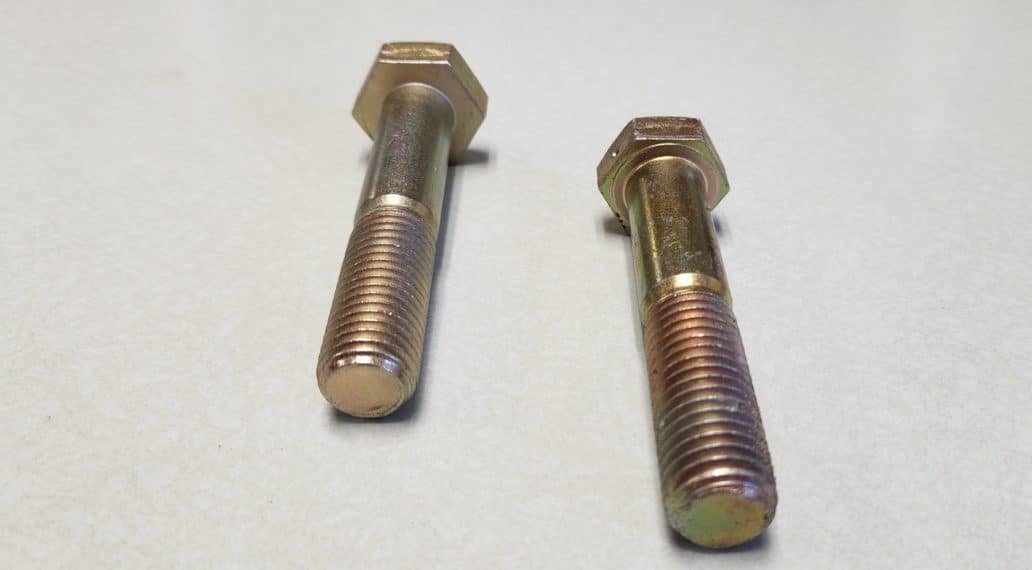
After the head is formed, the blank is a “headless screw.” The next critical step is to create the threads. How are screw threads made? The most common and effective method is thread rolling. Unlike cutting threads with a tap or die, which removes material, thread rolling is a cold forming process. The screw blank is forcefully rolled between two or three hardened steel dies whose faces are machined with the negative of the thread form. This immense pressure displaces the metal, forcing it to flow upward and outward to form the thread crests.
This method produces threads that are significantly stronger than cut threads because the grain flow of the metal follows the contour of the thread, increasing resistance to stripping and fatigue. Furthermore, the rolling process burnishes the surface of the thread, resulting in a smoother, more precise, and more consistent finish.
Fundamentals of Thread Rolling Die Design
The design of thread rolling dies is a science in itself. There are several types, including flat dies (where the blank rolls between two reciprocating plates), planetary dies (a central round die with orbiting segmental dies), and cylindrical dies (where the blank passes between two or three synchronized rollers). The designer must precisely calculate the starting blank diameter (the pitch diameter) to ensure the material displaces correctly to form a full-profile thread. The lead-in taper, pressure angles, and surface finish of the dies are all critical parameters that determine the quality of the final thread.
Stage 4: Heat Treatment – Engineering the Screw’s Strength
For many applications, especially with steel screws, the part requires additional strength and hardness that cannot be achieved through cold forming alone. Why is heat treatment necessary? It’s a metallurgical process that alters the crystalline structure of the metal to achieve specific mechanical properties, such as high tensile strength and surface hardness, to prevent wear and deformation under load.
The process typically involves two main steps: hardening (quenching) and tempering. First, the screws are heated in a controlled-atmosphere furnace to a specific critical temperature (e.g., around 800-900°C for steel). They are then rapidly cooled, or “quenched,” in oil or water. This locks the steel in a very hard but brittle state called martensite. To reduce this brittleness and impart toughness, the screws are then tempered by reheating them to a lower temperature for a set period. This final step allows the manufacturer to precisely dial in the desired balance of hardness and ductility for the screw’s property class (e.g., Class 8.8, 10.9, 12.9).
Stage 5: Surface Finishing & Plating – Protection and Aesthetics
The final manufacturing step is the application of a surface finish. What is the purpose of a surface finish? The primary goal is to provide corrosion resistance, but finishes can also add lubricity (for easier driving), alter appearance (e.g., blackening for aesthetic reasons), or provide a base for painting.
There are dozens of available finishes, with the choice depending on the screw’s base metal and intended environment. This is often an electrochemical or chemical process where screws are tumbled in large barrels or racked and submerged in a series of cleaning and plating solutions.
| Finish Type | Corrosion Resistance | Appearance | Common Applications |
|---|---|---|---|
| Zinc Plating (Clear/Blue/Yellow) | Good | Silver/Blueish tint or iridescent yellow | General indoor/dry construction, electronics, automotive interiors |
| Hot-Dip Galvanizing | Excellent | Dull, slightly rough grey | Outdoor structural use, coastal environments, infrastructure |
| Black Oxide | Mild (requires oil) | Matte to glossy black | Tooling, firearms, applications where reflectivity is undesirable |
| Nickel Plating | Very Good | Bright, reflective silver | Decorative hardware, electronics, plumbing fixtures |
| Passivation (for Stainless Steel) | Enhances inherent resistance | No change to appearance | Medical, food processing, and marine applications |
Stage 6: Quality Control & Sorting – Ensuring Perfection
Throughout the entire workflow and especially at the end, rigorous quality control is paramount. How do you ensure every screw is perfect? Modern manufacturers use a combination of in-process checks and final inspection. High-speed optical sorting machines use cameras and lasers to inspect 100% of the parts for dimensional accuracy (length, diameter), head defects, thread presence, and straightness, rejecting any non-conforming parts automatically.
In addition to automated sorting, quality labs perform manual checks using precision instruments like digital calipers, micrometers, and thread profile projectors. Mechanical testing is also conducted on sample batches to verify hardness, tensile strength, and plating thickness, ensuring full compliance with international standards like ISO, ANSI, and DIN.
Deep Dive into Screw Mold (Tooling & Die) Design Fundamentals
The success of the entire production workflow hinges on the quality and intelligence of the tooling design. While the machines provide the force, the dies provide the form. This is where a manufacturer’s true expertise is revealed.
The Guiding Principle: Material Flow
The single most important principle in cold forming die design is the controlled flow of material. The designer’s goal is to shape the metal into the final part geometry without creating any defects. This means carefully calculating volumes, designing smooth transitions, and planning multi-stage operations to ensure the metal moves where it’s supposed to. Improper design can lead to common defects like under-fill (incomplete part formation), cracking (over-stressing the material), or flow lines that create structural weaknesses.
Key Design Considerations for Cold Heading Dies
Designing a heading die is a complex task that balances physics, metallurgy, and geometry. Key considerations include:
- Volume Consistency: The volume of the initial wire blank must be precisely calculated to equal the final volume of the headed part. Too little material results in an incomplete head; too much results in “flash” or excessive pressure that can destroy the tooling.
- Multi-Blow Design: Why are multiple punches needed? For any head that is not a simple round or flat shape, trying to form it in a single strike would require too much force and likely fracture the blank. A multi-blow progression (e.g., a first punch to gather material and a second to form the recess and final shape) allows the metal to be formed gradually and correctly.
- Recess Formation: The design of the punches for drive recesses like Phillips, Torx, and hex sockets is extremely complex. The punch must not only create the shape but also do so while promoting correct grain flow for strength, ensuring the drive won’t strip under torque.
- Tool Materials & Coatings: The selection of die material (e.g., M2 tool steel, D2 tool steel, or solid Tungsten Carbide) depends on the complexity of the screw, the material being formed, and the required production volume. Advanced PVD coatings like Titanium Nitride (TiN) or Titanium Carbo-Nitride (TiCN) are often applied to reduce friction, prevent metal adhesion, and dramatically increase the life of the tool.
Key Design Considerations for Thread Rolling Dies
Thread rolling die design is equally critical for the screw’s performance. The final thread quality depends entirely on these tools.
- Blank Diameter Calculation: As mentioned, the blank to be threaded is not the major (outer) diameter of the final screw. It is roughly the pitch diameter (the theoretical midpoint of the thread). The die designer must calculate this precisely so that as the material is displaced, it forms both the thread root and the thread crest perfectly.
- Die Taper and Entry: The leading edge of a thread rolling die is tapered. This allows the die to smoothly engage with the blank and begin the forming process gradually, preventing skidding and ensuring a concentric, high-quality thread from the very first rotation.
- Matching Sets: Thread rolling dies are produced and used as matched, synchronized sets. Mismatching dies or allowing them to go out of sync will result in defects like drunken threads (improper helix angle), slivers, or incomplete thread forms.
Partnering with the Right Manufacturer: What to Look For
Given the complexity of the screw production workflow and the critical nature of tooling design, choosing the right manufacturing partner is essential. Your supplier should be more than just an order-taker; they should be a technical expert who can guide you to the optimal solution.
In-House Tooling & Design Capability
A key differentiator is a manufacturer’s ability to design and fabricate their own tooling in-house. This capability, a core strength at RivetJL, provides immense advantages. It allows for rapid prototyping of custom designs, faster turnaround times, complete control over quality, and the deep, hands-on expertise needed to troubleshoot and optimize even the most challenging fastener designs.
Material Expertise and Sourcing
Your partner should possess deep metallurgical knowledge and established relationships with reputable raw material suppliers. They should be able to ask the right questions about your application to recommend the most suitable and cost-effective material and heat treatment profile to meet your performance specifications.
Comprehensive Quality Assurance
Look for a manufacturer with robust, documented quality assurance processes. Certifications like ISO 9001 are a baseline indicator of a commitment to quality. Ask about their inspection capabilities—do they use modern optical sorting equipment? Can they provide detailed inspection reports, material certifications, and plating certifications?
Conclusion: The Symphony of Precision in Screw Manufacturing
From a simple coil of wire to a high-strength, precision-engineered component, the journey of a screw is a testament to modern manufacturing. It is an intricate process where the production workflow and tooling design are inextricably linked. Each stage, from material drawing to final sorting, relies on the preceding one, and the entire system is governed by the precision of the dies and tools that shape the metal.
Understanding this complete guide to screw production gives you the knowledge to better specify your requirements, evaluate suppliers, and appreciate the engineering packed into every single fastener. For projects that demand uncompromising quality and custom solutions, partnering with an expert manufacturer like RivetJL, who masters both the workflow and the art of tooling design, is the key to success. Contact RivetJL today to discuss your custom screw requirements and leverage our end-to-end manufacturing expertise.