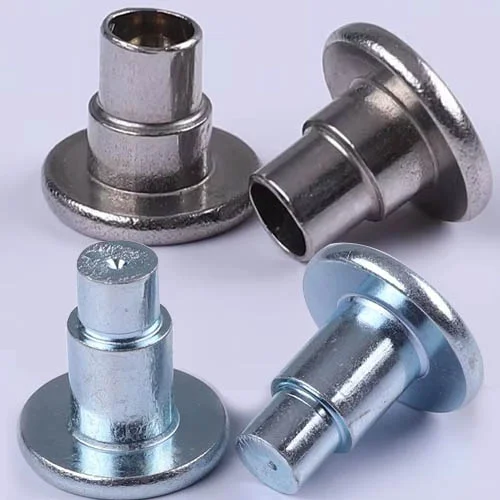
Shoulder rivets (also known as shoulder pins or unthreaded standoffs) are precision-engineered components. Unlike standard blind or solid rivets that merely clamp materials together, a shoulder rivet acts as a high-precision axle, a structural spacer, or a frictionless pivot point within a moving assembly.
Because their primary function relies on mechanical movement and exact spatial clearance, ordering custom shoulder rivets requires strict attention to detail. Submitting a vague RFQ (Request for Quote) to a manufacturer guarantees project delays, binding mechanisms, or premature wear.
Based on decades of OEM manufacturing experience at RivetJL (Dongguan Jiliang), this guide breaks down the five non-negotiable specifications you must define on your engineering drawings to secure the perfect custom shoulder rivet.
Spec 1: Dimensions and Micro-Tolerances (The Critical Blueprint)
Defining dimensions is straightforward; defining the allowable variance (tolerance) is where engineering expertise is required. The shoulder is the active bearing surface of the joint, making its dimensions the most critical aspect of the fastener.
Your technical drawing must clearly define:
Shoulder Diameter (with Fit Tolerance): If the rivet acts as a pivot, the shoulder diameter must perfectly match the mating bore. Specify exact clearance fits (e.g., an h7 or g6 metric tolerance or ±0.015mm) to prevent radial play (wobbling) while ensuring smooth rotation.
Shoulder Length: This dictates the exact axial clearance of the assembly. A length that is too short will compress and seize the moving arm during installation; too long, and the joint will rattle.
Tenon (Shank) Diameter & Length: The tenon is the section that gets upset (clinched). Its length must precisely calculate the thickness of the mating plate plus the material volume required to form a secure roll or bucked tail.
Concentricity (TIR): For high-speed or highly sensitive mechanisms, specify the Total Indicator Reading (TIR) to ensure the tenon is perfectly centered with the shoulder.
Pro Tip from RivetJL: Over-tolerancing increases costs exponentially. Work with our engineers to apply tight tolerances (±0.02mm) only to the critical shoulder, while allowing standard commercial tolerances on the non-functional head diameter to optimize manufacturing costs.
Spec 2: Metallurgy and Material Grade Selection
The base material dictates the fastener’s shear strength, fatigue life, and environmental survivability. Never simply specify “Steel” or “Stainless.” You must specify the exact grade based on the operational load and environment.
| Material Grade | Engineering Characteristics | Ideal OEM Applications |
| Low-Carbon Steel (1008 / 1022) | Highly ductile for flawless clinching, cost-effective. Requires plating for corrosion resistance. | General automotive interiors, furniture linkages, indoor hardware. |
| Alloy Steel (4140) | Exceptional shear strength. Often heat-treated for high-load applications. | Heavy machinery, structural pivots, suspension components. |
| Stainless Steel (304 / 316L) | 304 offers excellent general corrosion resistance. 316L (Marine Grade) resists pitting from chlorides and harsh chemicals. | Medical instruments, food processing equipment, marine hardware. |
| Solid Brass (C26000) | Excellent electrical conductivity, natural lubricity for pivots, anti-sparking. | Electrical switchgear, decorative leathercraft, explosive environments. |
| Aluminum (5056 / 6061) | High strength-to-weight ratio, non-magnetic. | Aerospace interiors, lightweight electronics enclosures. |
Spec 3: Head Geometry and Bearing Surface
The head of the shoulder rivet serves as a thrust bearing surface and a structural stop. Standardizing your head style reduces tooling costs, but custom geometries can solve unique clearance issues.
Truss / Large Flange Head: Provides a massive bearing surface, distributing heavy loads to prevent the rivet from pulling through soft materials like plastic or thin sheet metal.
Countersunk (Flat) Head: Engineered with precise under-head angles (typically 82° or 90°) to sit completely flush within the host material, essential for aerodynamic surfaces or sliding tracks.
Ultra-Low Profile / Pan Head: Used when axial space is severely restricted, providing a secure stop without interfering with adjacent moving parts.
Custom Features: Need anti-rotation? Specify under-head serrations or a D-shaped shoulder.
Spec 4: Surface Engineering (Plating and Finishes)
For carbon and alloy steels, surface treatment is mandatory. The finish not only prevents oxidation but can also drastically alter the coefficient of friction on the shoulder.
When specifying a finish, always include the required Salt Spray Test (SST) hours to ensure compliance.
Zinc Plating (Electro-galvanized): The industry standard for rust prevention (Clear, Yellow, or Black trivalent chromate). Specify thickness (e.g., 5-8 microns) to ensure it doesn’t interfere with your micro-tolerances.
Electroless Nickel (EN): Provides a uniform, hard, and highly lubricious coating. It is the premier choice for extending the wear life of the pivot shoulder without altering dimensions.
Passivation: A mandatory chemical treatment for Stainless Steel rivets that removes free iron and maximizes the natural, protective chromium oxide layer.
Black Oxide: Offers minimal corrosion resistance but provides a deep, matte black finish with zero dimensional buildup, ideal for optical instruments.
Spec 5: Production Volume (Scaling for Cost Efficiency)
Your required quantity directly dictates the manufacturing method we utilize, which heavily impacts your unit price.
Low Volume / Prototyping (100 – 5,000 pcs): Typically manufactured using secondary CNC machining or Swiss turning. The unit cost is higher, but it requires zero upfront tooling costs, making it ideal for R&D.
High Volume Production (50,000+ pcs): Manufactured using advanced Cold Heading (Cold Forming) technology. The metal is extruded under extreme pressure, resulting in zero material waste, superior grain structure (strength), and a drastically lower unit cost.
When submitting your RFQ, always include your Estimated Annual Usage (EAU). This allows RivetJL to amortize custom tooling costs over the life of the project, delivering the lowest possible price per piece.
Partner with RivetJL for Custom Fastening Solutions
Defining these five specifications is the foundation of a successful procurement cycle. The next step is partnering with an OEM manufacturer capable of executing them flawlessly.
At RivetJL (Dongguan Jiliang), we don’t just supply fasteners; we engineer solutions. Our facility is equipped with multi-station cold heading machinery, secondary CNC capabilities, and 100% optical sorting technology to guarantee 0 PPM defect rates on your custom shoulder rivets.
Don’t let ambiguous specifications compromise your assembly. Contact the engineering team at RivetJL today to submit your CAD drawings, discuss tolerance capabilities, and secure a reliable global supply chain for your precision fasteners.